

The 58th Winter School, hosted by the Petersburg Nuclear Physics Institute named by B.P. Konstantinov of National Research Centre “Kurchatov Institute”, took place in the town of Luga. The program featured several specialized thematic schools, including “Elementary Particle and Nuclear Physics” and “Theoretical Physics,” among others.
Presentations at the Winter School spanned a broad spectrum of cutting-edge topics across modern physics—from high-energy particle physics to astrophysics. Participants discussed the search for physics beyond the Standard Model, CP violation, baryon and lepton asymmetries, particle production mechanisms, hadron and nuclear structure, the neutrino mass puzzle, and advances in both effective and quantum field theories. Special attention was devoted to updates on the NICA accelerator complex, including the current status of the SPD (Spin Physics Detector) and MPD (Multi-Purpose Detector) experiments.
Plenary and parallel sessions drew significant interest, particularly talks by leading scientists such as:
· B. Arbuzov (JINR): “Scale Dependence of Factorization in Drell-Yan–Type Processes in QED”
· V. Guskov (JINR): “Status of the SPD Experiment at the NICA Collider”
· V. Kotikov (JINR): “Analytic Running Coupling in QCD”
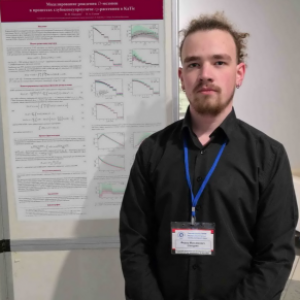
Representing Samara University, Fyodor Shapurin, a master’s student from the Department of General and Theoretical Physics, participated in the school with a poster presentation titled: “Modeling D-Meson Production in Deep Inelastic ep Scattering within the KaTie Framework.” (Supervisor: V. A. Saleev, Doctor of Physical and Mathematical Sciences, Professor, and Head of the Department of General and Theoretical Physics.) His work focused on D-meson production in electron–proton collisions, developed within the reggeized parton approach—a theoretical framework actively advanced by researchers at Samara University’s Department of General and Theoretical Physics.
