

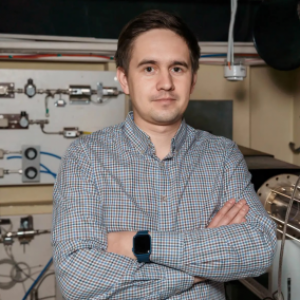
The Russian Science Foundation (RSF) has announced the results of its competitive grant program dedicated to research conducted by scientific teams led by young principal investigators. Among the distinguished winners are two outstanding research projects from Samara University:
- Enhancing the Efficiency of Small-Scale Gas Turbine Engine (GTE) Recuperators through the Application of Biomimetic Heat Exchange Surfaces.
Project Lead: Evgeny Blagin, Associate Professor at the Department of Heat Engineering and Heat Engines, and Senior Researcher at the Scientific and Educational Center for Gas-Dynamic Research (SEC GDR-209).
Project Focus: This research addresses the challenge of improving heat exchange efficiency by utilizing biomimetic (bionic) surface designs. The team plans to develop a novel optimization methodology for these surfaces using Computational Fluid Dynamics (CFD) modeling combined with machine learning techniques. The resulting data will be directly applied to the development of advanced recuperators for small-scale gas turbine units.
- Methods for Reducing Harmful Emissions in Civil Aviation Engines through the Use of Alternative Fuels.
Project Lead: Sergey Matveev, Associate Professor at the Department of Heat Engineering and Heat Engines, and Senior Researcher at Research Laboratory 101, "Physics and Chemistry of Combustion."
Project Focus: This project tackles the critical issue of aviation decarbonization by transitioning to the co-combustion of kerosene and hydrogen. The researchers aim to determine the optimal methods for this dual-fuel combustion to maintain engine reliability while significantly reducing CO₂ and soot emissions. The findings will serve as a foundational basis for developing new, environmentally friendly Russian aviation engines.
The research for both projects will be conducted over the 2026–2027 period.
These RSF grants are specifically allocated to support fundamental and exploratory scientific research. The funding amounts to 3 to 6 million rubles annually for each project, providing crucial financial support for the university's young researchers to drive technological innovation forward.
