

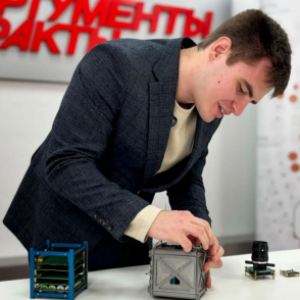
A team of young scientists at Samara National Research University is bringing to life a satellite development project that has received state support in the competitive phase of the "Personnel for Space" federal project. The students will design, assemble, and prepare for launch eight spacecraft that are changing the paradigm of orbital operations. The deadlines are tight, and the tasks are complex. A correspondent for samara.aif.ru discussed them with the project's chief designer, postgraduate student Sergey Ivlev.
At the Forefront of Modern Space Exploration
Micro-miniaturization of orbital spacecraft is one of the key trends in global astronautics, an industry that is no longer drifting but rapidly accelerating towards commercialization—maximizing returns while minimizing costs. Large, multi-ton spacecraft carrying complex equipment are certainly still needed, but if some tasks can be solved by ultra-small ones, why not save millions of rubles?
CubeSat technology was put on stream at the turn of the millennium. These apparatuses bear little resemblance to the huge satellites of the 20th century. They are essentially a frame with a 10 cm side, packed with electronics. Such basic cubes (or "units") can be launched into orbit individually or assembled into sets depending on the mission requirements. They are usually deployed into space not independently, but attached to a larger carrier spacecraft.
"After the main spacecraft separates, these satellites, which are attached to it in large numbers, are deployed, ejected from a special launch container, enter their own orbit, and begin their individual missions. Most often, these are targeted experiments that can be carried out using small apparatuses. Both large companies and universities, as well as small startups, are now engaged in this. There are even school-level spacecraft," says Sergey Ivlev.
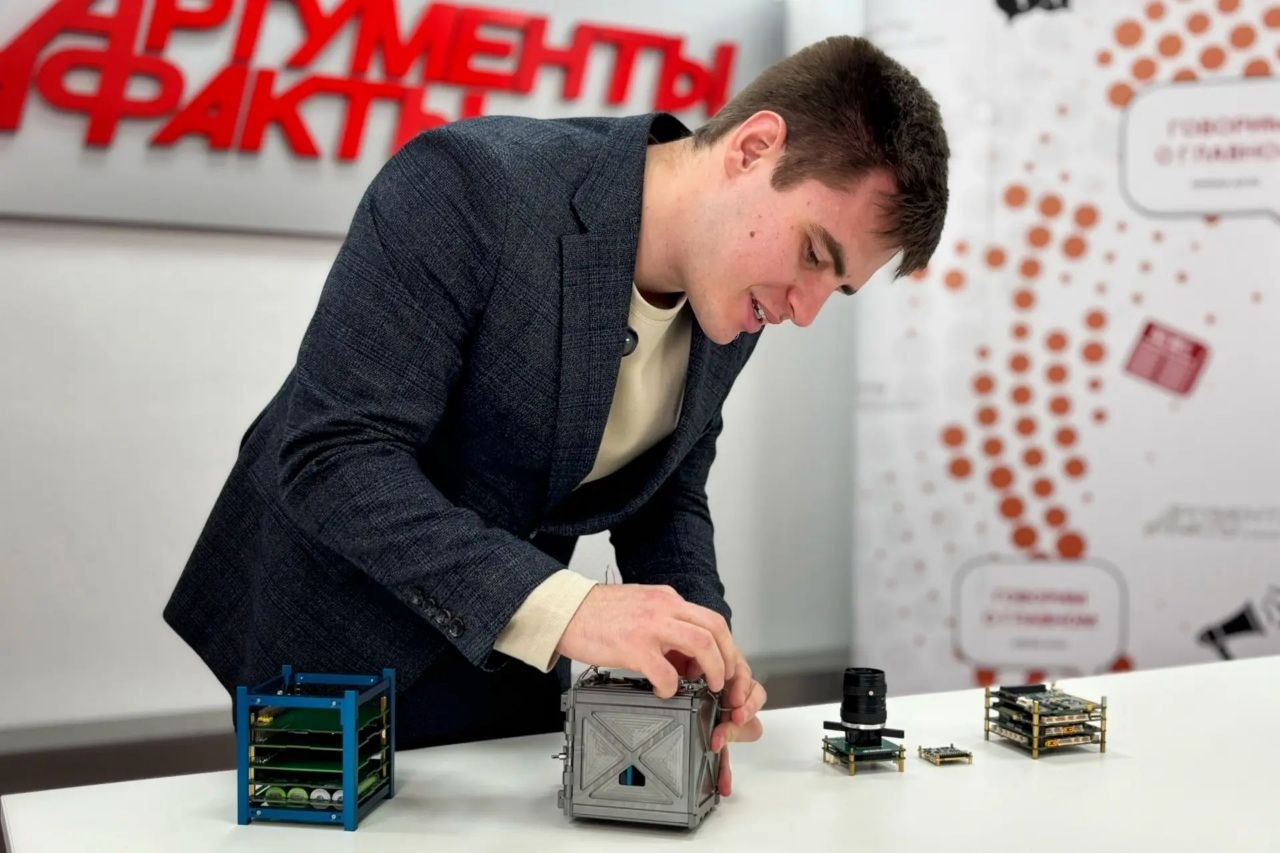
This technology represents the present day. But in the editorial office of AiF-Samara, Sergey Ivlev pulls the future out of an impressive case. Its name is the "tinysat" (from the English word "tiny"). This apparatus, measuring 10 cm in length and only 5 cm in width, is a fully functional spacecraft. In the Samara University project, there will be eight such apparatuses, launched from a single carrier satellite like a "space Matryoshka."
"The format was tested in 2023 during a test launch under the Space-π project. Our team worked on the 'babies' as part of the StratoSat-TK1 space mission (Startonautica LLC), where an experiment on delivering such apparatuses to orbit and separating them using a container was conducted in practice. The main idea of this format is to launch an entire constellation of satellites for the price of one CubeSat, without losing functionality or even expanding it," explains Sergey Ivlev.
Small but Practical
The main challenge is fitting complex electronics into the limited dimensions of each apparatus. After all, this is no longer just an experiment, but technology that must bring practical benefits.
"By reducing the dimensions, we are forced to miniaturize the onboard equipment as well. In this apparatus, half of it—that is, one unit—is allocated for service systems: the onboard computer, attitude control, and power supply. The second cube is entirely dedicated to the payload, which houses a photo camera," the chief designer explains, showing us the future satellite.
Sergey Ivlev notes that one of the main practical applications of the apparatus is the "Internet of Things" (IoT). This is a technology where not only people communicate with each other over a network, or a person with a machine, but the devices themselves exchange data autonomously.
"For example, this could be used for monitoring gas pipelines and pipe infrastructure. In the Far North or the Far East, it is impossible to lay internet cables to every segment of a pipe. Our idea is to create a small ground terminal with a solar panel and sensors, and launch a constellation of our apparatuses. Each is equipped with an IoT radio receiver that can receive signals from multiple subscribers simultaneously and accumulate data on board. When flying over the flight control center, the apparatus uses a high-speed transmitter to send the information to Earth. Thus, we can monitor the condition of pipelines in hard-to-reach areas almost continuously," the scientist says.
The advantage of an ultra-small constellation over a single large satellite lies not only in its low cost but also in the frequency of communication sessions.
"One apparatus completes an orbit around the Earth in about an hour and a half. This means that the delay in data transmission from a single satellite can be up to an hour and a half. We, however, are launching eight tinysats. The constellation will be evenly distributed across the globe. That is, the hour and a half can be divided among eight apparatuses. As a result, our satellite will fly over each subscriber every 10 to 20 minutes," the designer explains.
The satellites are also equipped with a photo camera payload. Due to the high frequency of flyovers, the images will allow for the tracking of ground processes in real-time dynamics. For example, monitoring the movement of Arctic ice along the Northern Sea Route.
Challenges and Solutions
Conceiving the project, the young scientists set themselves several challenges at once, which could provide answers to a number of questions facing global astronautics.
One of them is orbital control. None of the eight apparatuses has its own propulsion engines; there is simply nowhere to put them. However, after separation from the carrier, the constellation needs to be evenly distributed in orbit.
"This is one of the key areas of modern space operations—passive attitude control. There is a vacuum in orbit, but there are residual atmospheric gases—rare air molecules that create aerodynamic drag. By orienting the apparatus, we can increase or decrease this drag. The apparatus has small reaction wheels, which we can rotate to orient it with its narrower side forward. Experiencing less drag, it will slow down more slowly than the others. Meanwhile, its 'neighbor', which we orient differently, will experience aerodynamic drag over a larger area, meaning it will brake harder. Thus, according to our calculations, in 10 days we will be able to achieve a constellation that is evenly distributed across the globe and ensures frequent flyovers," Sergey Ivlev shared.
Another extremely complex task is data exchange within the constellation itself.
"We have a command and telemetry transmitter designed to transmit basic information about the apparatus's functions to Earth, for control, and for receiving commands. With its help, 'neighbors' in the constellation will be able to communicate over a mesh network, similar to how devices communicate via routers. This task is primarily related to software development," the chief designer explained.
The Team and Deadlines
The core team consists of eight students: electronics engineers, programmers, designers, and mathematicians. Design, calculations, documentation, and hardware implementation are all in their hands. Additional staff from among the students are also involved, while teachers act as mentors and experts.
The deadlines are very tight. However, conditions for fast and high-quality work have been created: winning the "Personnel for Space" project competition and receiving state funding allowed the university to purchase new equipment for working with the electronics of ultra-small satellites and testing them on Earth.
"The design phase of the apparatus is now complete. You can already see the technological prototypes," says Sergey Ivlev. "Now we are launching their mass production. We need to assemble 12 to 15 such apparatuses, eight of which will fly. The rest will remain on Earth for further technology refinement. The entire project must be completed by the end of 2026 and will await its launch into orbit."
Source: samara.aif.ru
Photo: Marina Efremenko
