

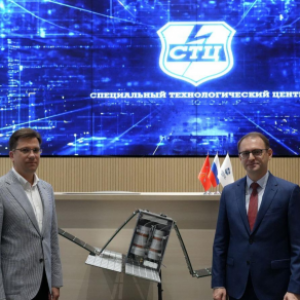
The first in Russia small-sized CubeSat radar monitoring spacecraft “AIST-ST”, equipped with a synthetic aperture radar and designed for X-band radar monitoring of the Earth’s surface, has successfully passed all ground tests and is ready to be launched into outer space.
The small-sized radar monitoring spacecraft capable of using the centimeter range of radio waves to “see” through dense clouds has been created by scientists and engineers at Samara University, together with specialists of the Special Technology Centre (STC LLC) from St. Petersburg. “AIST-ST” is to become the first domestic satellite in the CubeSat format, bearing radar equipment installed onboard: previously, in Russia, only larger spacecrafts were equipped with radars. Launching the satellite is tentatively scheduled for the end of December 2025, together with the SSS “AIST-2T” produced by RCC Progress JSC.
“The SSS “AIST-ST” has successfully passed ground tests, including a number of tests simulating the conditions of outer space. The spacecraft is ready for the launch campaign scheduled for the end of this year. Due to its radar equipment, “AIST-ST” will be able to monitor the Earth’s surface at any time of the day and night, as well as in any weather, regardless of the illumination and weather conditions on the Earth. For example, by using it, it will be possible to determine the ice thickness from outer space during ice exploration and the laying of icebreaker routes in the Arctic and the Antarctic and solve other tasks important for the country. The work on designing and constructing the spacecraft was carried out jointly with our partner, STC LLC, under the Federal Program for Strategic Academic Leadership “Priority 2030” and the Federal Project “Advanced Engineering Schools”. Our fruitful joint work will continue: on November 10, our University and STC LLC signed the relevant agreement on strategic cooperation”, said Vladimir Bogatyrev, Rector of Samara University.
The agreement provides for the joint implementation of R&D in the field of developing, constructing, testing and operating modern aerospace equipment, including devices related to creating and operating small-sized spacecrafts with various types of target equipment. It is also planned to jointly develop and implement advanced technologies, instruments and devices for unmanned aerial vehicles and spacecrafts. Besides, the agreement provides for joint participation in regional, federal and international programs for developing science, technology and equipment; joint development and implementation of educational programs aimed at training of highly qualified personnel, as well as the implementation of industrial and pre-graduation practices at STC LLC.
The topic of continued cooperation was also raised at the themed meeting “Advanced Technologies for Space Systems and Services”, held by the STR (Scientific and Technical Research) Centre this week at STC LLC. Ivan Tkachenko, Deputy Rector of Samara University, Director of the Institute of Aerospace Engineering, presented at the meeting the project for developing a space platform designed to operate in orbits of 200–300 km.
“Currently, there is a growing interest in using ultra-low Earth orbits. It is a specific orbit, the height of which ranges from 100 to 350 km. For optical surveillance equipment, main advantages of using ultra-low orbits, compared to higher ones, are increasing spatial resolution with similar technical specifications; for radar and lidar payloads – improving the signal-to-noise ratio; for telecommunication spacecraft – improving communication parameters. Moreover, when creating a device designed to operate in such orbits, it is possible to reduce its mass and dimensions while maintaining the specified parameters of the target equipment, which is especially beneficial for solving the problems of remote sensing of the Earth”, noted Ivan Tkachenko.
About the small-sized spacecraft “AIST-ST”
The small-sized spacecraft “AIST-ST” is designed in the 16U CubeSat format (16 units, that is, 16 interconnected “cubes”, each measuring 10x10x10 cm). Scientists from Samara University took part in developing the space platform for the satellite and created the set of scientific equipment; specialists from STC LLC – target radar equipment and the propulsion plant. In 2024, this project won the contest under the Program “Planet Duty Officer” and received financial support from the Innovation Promotion Foundation within the framework of the Space-Pi educational project, which allowed it involving the school audience.
The radar equipment will operate in the X-band of radio frequencies, this is the range from 8 to 12 GHz (wavelength from 3.75 to 2.5 cm). Due to the radar equipment, it will be possible to monitor the Earth’s surface regardless of the time of day and night, the level of illumination, in any weather conditions. Optical observation spacecrafts cannot perform such tasks.
The active life of the small-sized spacecraft “AIST-ST” is expected to be at least one year, with estimated working orbit 500 km high. The maximum inclined observation range is 500 km, the capture band is at least 70 km. From the estimated altitude, the radar equipment made by STC LLC is capable of providing a resolution of about 12 m in the route mode, and at least 2.5 m in the detailed mode.
The data from the spacecraft will be received by the ground-based small-sized spacecraft control system deployed on the University’s territory. The information obtained from the SSS will also be used when working with teams of schoolchildren under the Program “Planet Duty Officer” of the Innovation Promotion Foundation.
Cosmic “dust” will be weighed on the quartz scales
A scientific experiment on weighing cosmic “dust” will also take place on board the small-sized spacecraft. During the flight, the special measuring module developed by students and young scientists of Samara University will measure the degree of contamination of the outer surface of the satellite body due to the effects of the so-called own external atmosphere, which appears around the spacecraft in outer space.
Similar experiments and research have been conducted before, but on larger facilities, for example, on large satellites and on the International Space Station, without previously conducting this experiment on cubesats. The results of the experiment will help improve quality of the optical and radar equipment of the Earth remote sensing satellites.
For reference:
The Special Technology Centre (STC LLC, St. Petersburg) is one of the leaders in developing and producing special equipment and complexes for automated radio monitoring, information security, unmanned aviation and communication systems.
“Planet Duty Officer” is a program combining technology competitions and space-related projects for schoolchildren. The program aims at raising awareness of space research and developments among Russia’s general youth and schoolchildren. The program is organized by the Innovation Promotion Foundation, the Skolkovo Institute of Science and Technology, Roscosmos State Corporation and the STI Club Movement.
* Space-Pi (Space π) is the All-Russian science-and-education project for developing and producing small-sized CubeSat-format spacecrafts on domestic satellite platforms, aimed at forming the grouping of about 100 3U CubeSats in orbit for several years, in order to create the infrastructure for involving schoolchildren in research and technical creativity in the field of space technologies.
