

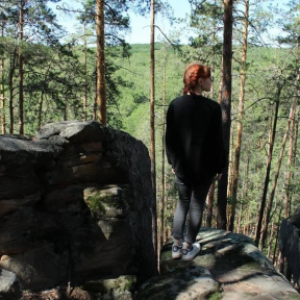
The online publication “Archipelago of Wild Nature in Samara Oblast” recently published an interview with Polina Yemelcheva, a second-year master’s student at Samara University’s Faculty of Biology. Polina shared her vivid memories of the Rachey Taiga, recounted her participation in the emergency response during the devastating 2024 wildfire, and explained how that event reshaped the focus of her thesis.
About Science: “I Wanted to Feel Like a Pioneer”
— When did you first visit the Rachey Taiga, and why did you choose it as the subject of your research?
— I’d seen photos of the area before and was captivated by its beauty. Four years ago, during my third year of undergraduate studies, I traveled there with Yevgeny Sergeyevich Korchikov (Associate Professor at the Department of Ecology, Botany, and Nature Conservation) and a group of students originally from the region.
— What did you study back then? How did your exploration of this natural monument begin?
— We chose a largely unexplored topic: fungi. We wanted to feel like true pioneers. Before us, only rare plants and animals listed in the Red Data Book had been studied there. We focused specifically on basidiomycetes—the familiar “mushrooms with caps” visible to the naked eye.
— What does fungal field research actually look like? Do you know where to find them? What methods do you use?
— In well-studied areas, scientists rely on geotags to revisit known sites. But here, nothing had been mapped. We followed a rough route and tried to spot as many fungi as possible. We collected everything we saw: bracket fungi growing on trees, mixotrophs (organisms that combine organic and inorganic nutrition), and soil-dwelling species. Using small knives, we cut samples, placed them in handmade paper envelopes, labeled each with location data, substrate type, family, genus—and recorded GPS coordinates. Back at camp, we used field guides and morphological keys to tentatively identify our finds. But accurate identification is nearly impossible in the field. That work continued later in university labs, using microscopes and chemical reagents to examine spores and soften tissues for detailed analysis.
— Do you now have a fungal map of the Rachey Taiga?
— Yes. Every specimen we collected was geotagged, so we now have a preliminary understanding of species distribution across the territory.
— Approximately how many basidiomycete species are found in the Rachey Taiga?
— So far, we’ve identified around 40–50 species, eight of which are listed in the Red Data Book of Samara Oblast.
— Was there any discovery that particularly amazed or delighted you?
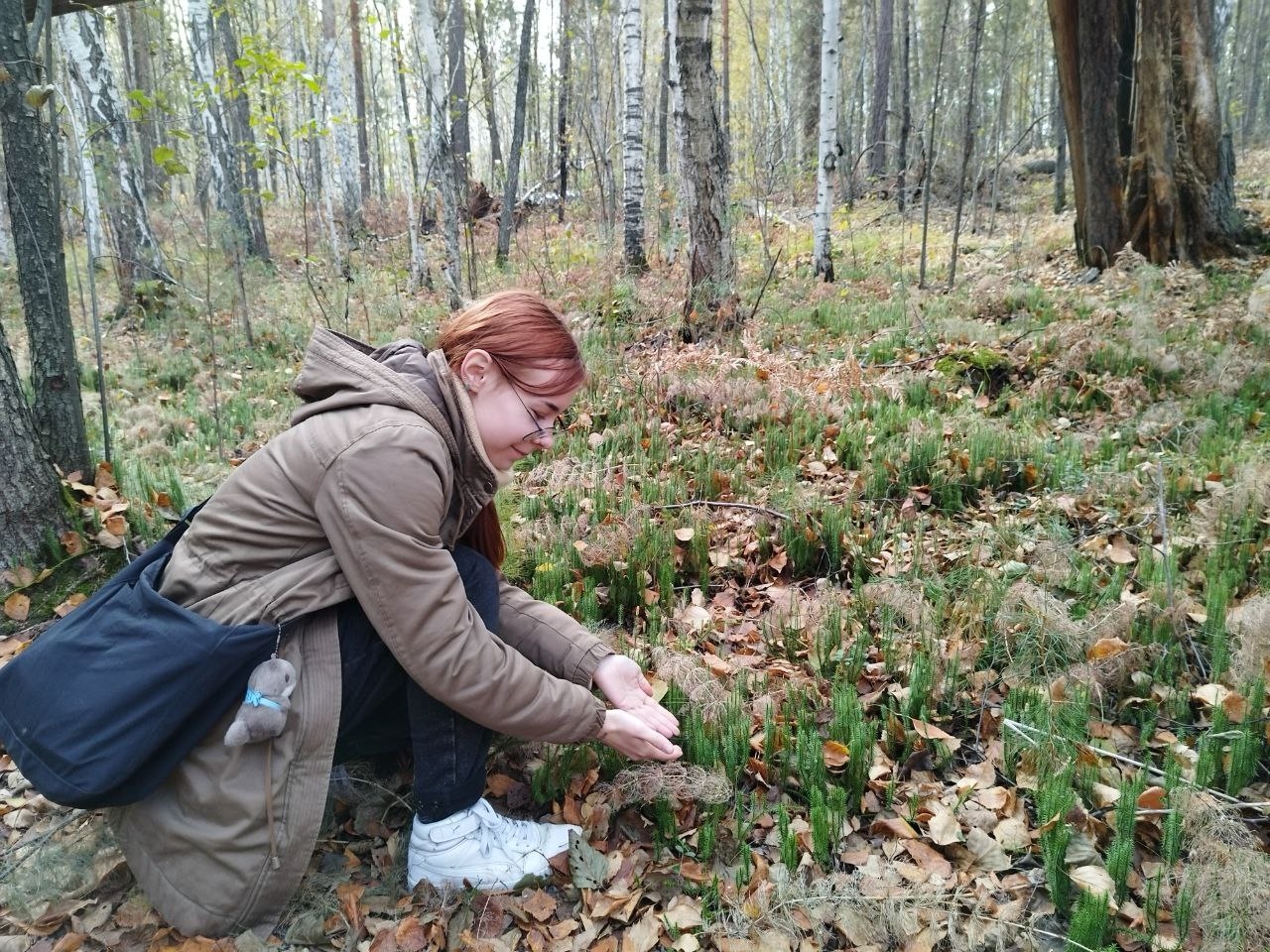
— Not among the fungi—but yes, among plants: Clubmoss (Lycopodium clavatum) and Annual Clubmoss (Lycopodium annotinum). Both are extremely rare, and both grow in the Rachey Taiga.
On Fire and Loss
— You took part in the response to the wildfire that struck the Rachey Taiga in autumn 2024. How did it unfold?
— Yevgeny Sergeyevich informed us about the fire. I felt deeply unsettled—I’d already developed an emotional, almost empathetic bond with the place. It happened to be a free day, so I thought, Why not go? I saw a post saying Alexey Pazhenkov (head of the Ecoton Laboratory of Conservation Biology) was organizing a volunteer trip, and my friend Anastasia Pivneva and I joined the group.
— What did you do on-site?
— We carried water. We brought lots of old denim clothes, soaked them, and used them to smother small flames and smoke sources. We poured water into depressions filled with deep organic litter—the kind that continues burning underground even when the surface looks calm. Visually, there seemed to be no fire, but if you dug just a little, you’d find smoldering layers that needed extinguishing. We didn’t tackle open flames—that was handled by professional firefighters and EMERCOM crews.
— How did you locate areas needing help?
— We drove along the accessible perimeter, watched for smoke or flames, stopped wherever we saw activity, and did what we could. We returned to the taiga in autumn 2025—our first visit after the fire—to assess which species survived, especially the clubmoss.
— What were your first impressions of the burned landscape?
— The most heartbreaking sight was the birch forest. I still have photos of how it looked before—so vast, so beautiful, dense with birches… and clubmoss growing right beneath them. After the fire, the trees had collapsed, the ground had turned swampy—it was devastating. The clubmoss at that site was completely gone. We found only dried, dead stems.
— Can clubmoss recover in that exact spot?
— I doubt it. Clubmoss is highly sensitive to temperature extremes and especially to fire. We did find some elsewhere—but far from the birch grove.
— And what about the fungi? How did they fare?
— Fungi are remarkably resilient. Almost all the species we recorded before the fire reappeared afterward. The fungal kingdom was barely affected by the blaze.
“It’s Better Not to Pick Mushrooms Anywhere”
— Is your thesis focused on fungi?
— Yes—but it’s evolved. Originally, it was solely about basidiomycetes. Now it’s become a hybrid: basidiomycetes plus Red Data Book plants. The fire shifted my focus toward studying its ecological consequences rather than just describing the territory.
— What conclusions are you drawing in your research?
— First, a foundational inventory of fungal species present. Second, an assessment of fire impact: which species are resilient to catastrophes and which are vulnerable. We also have a physical collection—from trips both before and after the fire—and we visually compare specimens to evaluate damage.
— On the way to Rachey, locals in nearby villages sell lots of wild mushrooms. As someone who studies the taiga’s fungi, what’s your take?
— It’s better not to pick mushrooms anywhere at all. Let them grow undisturbed. Even experts can’t always identify a mushroom correctly in the field. Many toxic species closely resemble edible ones—sometimes indistinguishably so. Confirming edibility requires lab analysis: microscopy, chemical tests—tools no forager carries. Without them, you’re gambling with your life.
— Do you eat mushrooms yourself?
— Very rarely.
Photos from Polina Yemelcheva’s personal archive
