

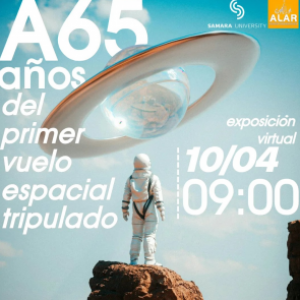
The Museum of Aviation and Cosmonautics at Samara National Research University hosted a virtual tour and quiz for schoolchildren from Peru, Mexico, Ecuador, Colombia, Guatemala, and other Latin American countries—timed to mark the 65th anniversary of the first human spaceflight. The event was led in Spanish by two students from the Center for Russian Language Promotion: Sebastián Sifuentes Savala from Mexico and Luis Fernando Castillo Ortiz from Costa Rica.
Conducted entirely in Spanish, the tour allowed participants not only to view legendary artifacts but also to feel how deeply space unites Russia and their home region. It became clear that in today’s world, space is no longer the exclusive domain of just two or three superpowers—it has become a vibrant arena of international cooperation, with Latin America playing an increasingly prominent role. From Arnaldo Tamayo Méndez, the first Cuban—and first person of African descent—in space, to PeruSat-1, Peru’s advanced Earth observation satellite, and world-class astronomical observatories in Chile, the region’s contributions are undeniable.
During the tour, students touched living history. They saw the lucky hat that Sergei Korolev, the chief designer of the Soviet space program, wore before rocket launches—a personal talisman symbolizing his hopes for success. They learned that the iconic R-7 rocket, which launched humanity into the space age with Sputnik in 1957, evolved into the globally renowned Soyuz family of launch vehicles—still assembled today at the Progress Rocket Space Centre right here in Samara.
Particular fascination surrounded the story of the NK-33 engine, originally developed for the Soviet lunar program. Decades after that mission was shelved, upgraded versions of this powerhouse now propel both American Antares rockets and Russian Soyuz-2-1v launchers—showcasing how space technology transcends borders and generations.
The tour was more than a history lesson—it was proof that space erases boundaries. Participants discovered that knowledge of Russian remains essential for anyone aiming to work aboard the International Space Station (ISS): all astronauts must learn Russian to operate the Russian segment and communicate with Mission Control Center in Moscow.
To ensure the experience went beyond passive observation, the session concluded with a themed quiz in Spanish. Students answered questions about pivotal milestones they’d just explored—from the launch of the first satellite to the design features of the Sokol-1 spacesuit—solidifying their newfound knowledge through active engagement.
Author: Anna Berezina, Head of the Center for Russian Language Promotion
