

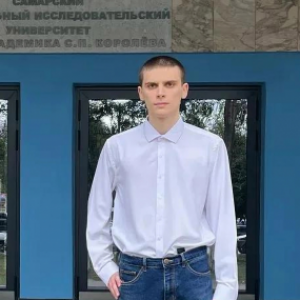
"In the world of finance, there is no room for chance—only prepared intuition or rigorously tested science." Andrey Korolev, the first recipient of the Yegor Gaidar Named Scholarship in the university's history, discusses how early setbacks in the stock market during high school became the foundation for his scientific work, why students need a financial safety net, and why helping others is more important than academic rankings.
— Tell us about yourself.
— I am a native of Samara and graduated from School No. 153. My main passion became stock market trading—a pursuit that, unfortunately, resulted in significant financial losses for me, but served as a harsh yet invaluable lesson. Raised by a mother who holds two university degrees, I absorbed her thirst for knowledge from childhood. Ultimately, I decided to follow in her footsteps, choosing a path of deep academic development for myself.
— Why did you choose economics and financial analytics?
— It is important for me to understand the underlying mechanisms of the stock market, analyze risks, and manage cash flows consciously. That is why I decided to turn my practical hobbies into a professional foundation. Back in the 8th grade, I became fascinated with the cryptocurrency market and financial platforms of various countries—trading on both the Russian and Chinese stock markets. It was then I realized that fundamental knowledge and an analytical approach would give me a much greater chance of success than intuitive strategies.
— What other scholarships do you receive, besides the state academic scholarship and the Gaidar scholarship? What is your income from academic activities?
— I have also received scholarships from the President of the Russian Federation and the Government of the Russian Federation, as well as a grant from the "Talent and Success" Foundation. For me, it is crucial to direct these funds toward building my own financial capital while simultaneously developing fundamentally new methodologies that will allow this capital to grow exponentially on a daily basis. This ambitious goal lies at the core of my scientific work. To achieve it, I am currently writing a monograph that will bring together innovative approaches capable, I am convinced, of sparking a genuine revolution in economic theory.
— How did you spend your first scholarship?
— On publishing a scientific paper in journals included in the VAK (Higher Attestation Commission) list. It was fundamentally important for me to introduce my research to the academic community as early as possible. I saved the remainder and later used it for additional education to expand my toolkit and deepen my understanding of related disciplines. Thus, the scholarship became a strategic investment in my own development and the foundation for future scientific achievements.
— How many conferences do you participate in per year?
— It is difficult to count: I strive to participate in as many as possible. It is fascinating to hear the opinions of industry specialists regarding the methodologies I have developed. However, my main focus remains on publications in scientific journals, as I believe they are the most weighty proof of scientific validity and allow me to convey my ideas to a broader and more demanding audience.
— You received the Yegor Gaidar Scholarship. How do you feel? What do you know about this economic figure?
— For me, the Yegor Gaidar Named Scholarship is not just another line on a list of achievements, but something much deeper and more profound. It has become a symbol that my research, built at the intersection of risk and analytics, has been noticed and recognized at the federal level, filling me with a sense of immense responsibility and pride. To be a laureate of a scholarship named after such a titan of economic thought as Gaidar, whose reforms and bold decisions still inspire both admiration and debate, is, for me, a kind of bridge to his legacy, a role model, and a benchmark I look up to. This scholarship has confirmed that my path is correct, and my goal is to break established boundaries and offer the world new, revolutionary methodologies capable of transforming economic theory.
— What is your research focus?
— I want to present a complete and realistic picture of the modern global economy. All the themes of my work—from commodity and resource economics to geopolitical shifts, neocolonial mechanisms, rent-seeking relationships, financial markets, institutional risks, and country analysis—are deeply interconnected. Each of these spheres, like links in a chain, influences the other, creating a complex pattern of the world order. Together, they allow us to see the holistic dynamics of the redistribution of wealth, power, and information. My research aims to develop, through the analysis of these intertwined structures, methodologies that make the economic landscape more transparent, predictable, and fair.
— Do you apply your financial analytics knowledge in real life?
— Absolutely. I systematically manage my budget with a clear division into mandatory expenses, investments, and savings. I am building what is known as a "financial safety net," which I consider a fundamental element of financial stability, allowing me to feel confident even in conditions of market volatility. At the same time, I regularly invest my free funds using strategies tested in practice, based on a deep analysis of macroeconomic indicators and behavioral patterns. Although my main goal is still in the implementation phase—namely, creating capital capable of multiplying through my proprietary methodologies—I already see how theoretical calculations are turning into real financial results. This confirms the correctness of the chosen path and provides additional motivation for further scientific research.
— How do you plan to develop further?
— I plan to develop sequentially in three interconnected areas, but science remains my priority. I intend to continue refining the methodologies I have created, deepening their theoretical foundation, and ultimately completing a monograph that will become the foundation of a new economic paradigm. In teaching, I see a powerful tool for transferring accumulated knowledge and for my own growth through dialogue with young minds. In the financial sector, I will be able to test my developments in real market conditions. In essence, all three spheres are merged into one for me, and I plan to work in this unified stream, constantly setting new challenges for myself and striving for professional excellence, because it is precisely this synergy that allows one to move forward faster and on a larger scale than any single direction.
— How does your day go, and how do you manage to do everything?
— Honestly, my day is a constant search for balance between chaos and discipline, and I still cannot say I have found the perfect formula. However, the main principle that helps me get everything done is simple: I try not to divide my life into "science" and "everything else." Instead, I weave my passions—whether it is market analysis, reading, or even discussing ideas with colleagues—directly into the fabric of my study and workday, turning every moment into a small research project. I do not have a rigid hourly schedule, but I do have an internal rhythm: I usually dedicate my mornings to the most complex tasks, such as working on my monograph or analyzing data; my afternoons to meetings, lectures, and consultations; and my evenings to analyzing trades or writing articles. At the same time, I always leave "windows" for unexpected ideas and new experiences, because they often provide the most valuable insights. The main secret, perhaps, is that I do not try to artificially "do everything"—I choose my priorities and allow myself to occasionally switch between tasks so my head doesn't boil over.
— How often do you experience stress? What nerves you? How do you cope?
— To be frank, stress has become such a familiar background for me that I have learned to perceive it not as an enemy, but as an inevitable companion of any serious activity. However, I experience it most acutely in moments when the market behaves unpredictably, where even the notorious "butterfly effect" can trigger a chain reaction, multiplying the tension and making me doubt my own calculations. Nevertheless, I cope with this by returning to my main anchor: science and methodology. When I see that my theoretical models still describe reality, even through the noise and chaos, I calm down and begin to act coldly and analytically, rather than emotionally. I switch off internal panic and replace it with a clear algorithm for testing hypotheses. Additionally, it helps me to realize that any losses are also data, valuable material for research. This means that even in defeat, I continue to move forward. Ultimately, I have simply come to terms with the thought that stress is the price of playing at a high level, and as long as I retain the ability to analyze, I remain in control of the situation.
— Do you have any other interests besides studying and science?
— My main additional passion is volunteering, which for me is not just a hobby, but a conscious life position. I purchase and bring groceries to a charitable organization, from where they are distributed among low-income populations and sent to the Special Military Operation (SMO) zone. For me, it is fundamentally important to emphasize that the main thing is the very fact of helping and providing timely support to those who need it. This work gives me a sense of belonging to something greater and reminds me that the economy, ultimately, must work for people, and not the other way around.
Rules for an Economically Successful Student: Andrey Korolev’s Version
- Healthy financial behavior for a student begins with an ironclad rule: playing with financial instruments—whether stocks, cryptocurrencies, derivatives, or betting—is a high-risk zone where there is no room for random decisions.
- Treat your education and scientific projects as your primary investment. The depth of your expertise determines your future market value, so spending on books, courses, and conferences is not an expense, but an investment that pays off with a huge multiplier.
- Keep the strictest records of income and expenses. Log every transaction to have a real picture rather than an illusory sense of control, because numbers do not lie.
- Automatically set aside at least 10–20% of all income into an untouchable reserve, building a financial safety net for 3–6 months of living expenses, which will serve as your anchor in any storm.
- If you decide to invest, do so only after deep analysis and with a cool head, without emotional swings. Remember, your goal is not speculative fever, but systematic, long-term growth based on calculated strategies.
- Constantly diversify your income sources: scholarships, grants, profile-related part-time jobs, and small projects. The more channels you have, the more resilient your system becomes.
- Never take out consumer loans for things that do not create assets, and treat credit cards as an emergency tool, not as a source of life financing.
- Healthy behavior is built on living within your means while constantly expanding your capabilities through knowledge and discipline. Remember: in the world of finance, there is no room for chance—there is only prepared intuition or rigorously tested science. Your task as a student is to choose your path consciously and walk it without illusions.
Text: Elena Pamurzina
Photos: Svetlana Orlova
