

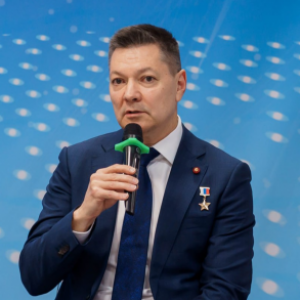
Oleg Kononenko is a Hero of Russia, a test cosmonaut instructor, commander of the Roscosmos cosmonaut squad, Acting Head of the Cosmonaut Training Centre, and Samara University’s honorary graduate! Five flights into orbit, seven spacewalks, and the total duration of his space flights is 1,110 days, 14 hours, 58 minutes, and 43 seconds.


Oleg Kononenko is now preparing to fly to the ISS (International Space Station) again. The students of the region’s universities learned about it. During the conversation, the guest also spoke about the place of robots in space exploration, the role of biotechnology in the exploration of deep space and how fate leads a person to his/her dream.
The meeting was held at Samara University. The guest was greeted by Mark Shleenkov, Minister of Science and Higher Education of the Samara Region, Vladimir Bogatyrev, Rector of Samara University, Victor Soifer, President of Samara University, Academician of the Russian Academy of Sciences, Evgeny Shakhmatov, Scientific Director of Samara University, Academician of the Russian Academy of Sciences.
Opening the meeting, Vladimir Bogatyrev stressed that Oleg Kononenko is an honorary graduate of Samara University and proposed to organize a permanent exhibition dedicated to the pilot-cosmonaut at the Museum of Aviation and Cosmonautics.
Dmitry Ilyich Kozlov is a world-class figure!
Oleg Kononenko presented certificates to the winners of the Dmitry Ilyich Kozlov Prize, to the students of Samara University, Samara Aviation College, D.I. Kozlov Samara College of Aviation and Industrial Engineering.
“The Samara government established this award for the purpose of linking the heroic past with the bright future of the Russian cosmonautics. At his time, Dmitry Ilyich played a key role in my life, it was he who helped me overcome a number of difficulties on the way to becoming a cosmonaut. Let Dmitry Ilyich indirectly take part in your fate through this award. I hope that my future colleagues are already growing up among you!” addressed Oleg Kononenko the young people.
Oleg Kononenko met Dmitry Ilyich Kozlov during his studies at the Institute. Then, at the Conference “Gagarin Readings”, Kozlov headed the section, where Kononenko, a student, presented his scientific work. His report was noticed, and the student was invited to work in Kuibyshev, in the Central Specialized Design Bureau (CSDB). Having dreamed of space since his childhood, the young man decided to take advantage of the invitation and chose the rocket enterprise located on the bank of the Volga River, when being distributed.
“I came to the HR Office and found out that future cosmonauts choose Moscow. I was upset, but decided that I needed the experience anyway”, recalls Oleg Dmitrievich. “At that time, the CSDB was a very ambitious and young team. We tried to prove ourselves and get into more profitable engineering positions. For example, at that time, the work on the spacecraft “Sapfir”, the predecessor of the modern spacecraft “Resurs-DK”, was underway. And I got into the group of its developers. This meant that we used to go on business trips all over the country, as the components were produced at different factories”.
Oleg Dmitrievich told the students that at some point he came to Kozlov and asked him to apply for his transfer to the cosmonaut squad. And although Dmitry Ilyich urged the young engineer to continue the work on the satellite, Kononenko was as determined as ever, “If I don’t try now, then I’ll spend my whole life “gnawing” myself!” And Kozlov accepted the arguments and made his recommendation. And the next five flights into orbit demonstrated how a dream brought a proper man into space.
Flights to Mars, robots and biotechnologies
At Samara University, meetings with students always takes place in the format of a lively, interested conversation. Here, we present excerpts from the meeting in the form of questions and answers.
“If you were offered to go to Mars now, would you agree?”
“We have not been ready to go to Mars yet. The main problem is radiation. There is such a thing as an accumulated dose of radiation: having flown beyond our planetary protection, beyond the magnetic belt, and having encountered galactic radiation, we will reach Mars, exhausted by radiation sickness. We need to wait for this problem to be solved either with the help of technology – developing protection for the spaceship, or with the help of biotechnology”.
“Robotic and unmanned complexes are actively developing now. And what are the advantages of humans in space?”
“The main advantage of a person is intelligence and flexible thinking. Automatons are most likely to be the first on the Moon and the Mars. They will develop and prepare the territory for the landing of humans. And it is a person that handle abnormal, emergency situations better. Therefore, one cannot mutually exclude or contrast a human with a robot. I believe that the future of cosmonautics lies in their symbiosis”.
“Please, tell us about Robot Fedor at the ISS?”
“I did not see Robot Fedor in orbit: it was sent there two months after my return to the Earth. It performed the simplest operations. In my opinion, the robot is a bit big for the ISS. But there is a lot of work for it outside. So, such devices are not useless. But one thing is clear: to date, no robot can replace a cosmonaut”.
“What technologies, in your opinion, should be developed, for advancing humanity into outer space?”
“Biotechnologies. They help create closed life-support systems, to make our lives autonomous. We must learn to live using limited resources to the maximum.
The example of such systems is the water regeneration system. Or creating bioreactors, in which algae absorb carbon dioxide from the atmosphere at the station and release oxygen. Moreover, algae – spirulina, for example, – can also be used as food. At the station, the “electronic nose” turned out to be very useful: it is a device that recognizes various odors and captures microbacteria. We conducted an experiment with photocatalysis, which destroys bacteria and purifies the air at the station better than mechanical filters. Therefore, biotechnologies have a future because of improving life both on the Earth and in outer space”.
Life in orbit
“How often did dangerous situations occur at the station during your flights?”
“There is such a notion as “emergency situations”. They happen to us in orbit every day. They are comparable to those on earth: the water suddenly stops flowing or the light bulb goes out. And such situations occur from time to time. But there are emergency situations that can result in the loss of the station and the death of the crew. I’ve never encountered anything like this.
We prepare for emergency situations during our training on the Earth. We are also ready for most emergency situations, and know the algorithm by heart.
Mentioning my first and last for today flights… I would compare them to the first school lesson and the defense of the graduation project at the university. The first flight was euphoric, and at the same time it was held under the motto “Do not break anything, cope with all the experiments”. I was getting used to weightlessness, the strict work schedule, and constantly checked my actions against the on-board documentation and the flight radiogram. Now I do the same thing. But nowadays, my adaptation is much faster to both weightlessness and the gravity on the Earth. I can predict how this or that situation will develop. I get my job done much faster now. And there is time to find solutions to some non-trivial scientific problems”.
“What repair was the most difficult?”
“During our spacewalk, Sergey Prokopiev and I cut out a piece of anti-meteorite protection. It was very uncomfortable and dangerous to do this in the fabric gloves of the spacesuit, since any puncture could lead to depressurization”.
“Does the movie “The Challenge” look like reality?”
“I haven’t watched “The Challenge”. But in terms of medicine, at the station, there is all the necessary set of medicines and medical supplies, in order to stop almost any problem. We also have a closed-circuit television channel where the crew doctor is in touch 24/7 with us.
Currently, we conduct quite a lot of medical experiments. For example, we do ultrasound scans of internal organs to each other. We study the work of the digestive system, heart, and other organs. Of course, it will be difficult to perform a surgical operation on board, but, if necessary, we can return to the Earth quickly enough”.
“What is the atmosphere at the station? Your interrelations?”
“One must understand that in orbit, we live in a very limited space: you wake up, emerge out of your cabin, and you’re already at work. There are the same faces all around. We need to be restrained, we learn very quickly to subtly feel each other’s mood. And we manage to hear each other and properly interpret what has been said. This allows avoiding conflicts and changing topics of the conversation in time.
It’s interesting, but at the station we talk mostly about earthly life, discussing earthly events”.
“Are there any habits that you have gained in outer space?”
“Rather, we bring our earthly habits into outer space. For example, I’m a coffee drinker. And when I drink from a sachet, I don’t smell the coffee. And this fragrance is very lacking. I am grateful for the invention of a special cup, into which you can pour coffee, and it will not break out of the cup due to surface tension”.
“How long is a cosmonaut’s working day?”
“Slightly longer than that on the Earth. The work schedule is 12 hours, of which 2 hours for physical education, one hour for lunch. At the ISS, life goes by GMT”.
GTO (Ready for Labour and Defense) by outer space standards
“How to become a cosmonaut?”
“The basic requirements: higher education, at least a master’s degree, work experience – at least 3 years. And then – submitting documents, face-to-face selection: medicine, psychological selection, professional one. A cosmonaut is a stress-resistant and socialized person, capable of teamwork, able to obey, despite his/her high leadership qualities. And it is also important to be able and willing to learn”.
“And what exams are needed to be taken?”
“The candidates will have to take two major exams. The first one is a simulation of one day at the station. We work out both routine tasks, as well as 6 abnormal and 1 emergency situations. The second exam is a day on a transport spaceship”.
“What helps you cope with stress?”
“One of the main selection points for cosmonauts is psychological. That is, first of all, stress-resistant people are selected. Further, the preparation itself is conducted in the way of our living under psychological pressure all the time: nobody knows when the flight will take place, heavy trainings, ongoing medical examinations. We sooner or later adapt.
The most difficult thing is waiting for the flight. Moreover, we are not just waiting, but constantly training, as we must be ready at any moment. I’ve been waiting for my first flight for five years. I was supposed to fly in 2003, but really get to the ISS only in 2008. Herewith, you should bear in mind that in 2003, I could not even predict when the flight would take place”.
“And what about the family?”
“The family’s support sometimes seems to me to make 99% of the success of every mission”.
“What do sports mean for your training?”
“Physical exercises on the Earth allow staying in the ranks and undergo medical examinations for as long as possible, and at the station, not losing muscles under the influence of weightlessness and having the opportunity for living normally on the planet after returning. I have an idea of creating an analogue of the GTO complex in accordance with the standards for cosmonauts. I wonder which of you will be able to overcome it?
Photo by: Olesya Orina
