

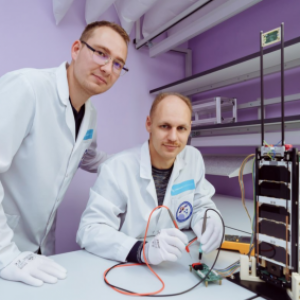
The educational nanosatellite "SamSat-Ionosphere", developed by Samara University and launched into space in 2024 to study Earth's plasma and magnetic shells, will join the global celebration of Victory Day with a unique tribute from orbit.

"From May 9 to 18, 2026, the SamSat-Ionosphere nanosatellite will broadcast a Victory Day greeting via its radio beacon every three minutes, reminding the international amateur radio community of this pivotal date in world history. The message will conclude with the words: 'Nothing is forgotten. 1941–1945,'" shared Leonid Sinitsyn, Head of the Nanosatellite Flight Control Center and Associate Professor at the Inter-University Department of Space Research, Samara University.
"Radio amateurs worldwide who receive this signal will be eligible to request a commemorative QSL card confirming reception from our satellite. The card features a miniature reproduction of the iconic photograph by wartime correspondent Yevgeny Khaldei, 'Raising a Flag over the Reichstag.'"
How to Request Your QSL Card
Radio enthusiasts wishing to receive the commemorative card should submit a request to the university at sinicyn.li@ssau.ru, including the following details:
- Full name
- Amateur radio call sign (if applicable)
- Date and time of reception (UTC)
- Location (city)
- Country
Transmission details:
- Frequency: 437.4 MHz (FSK 1200 bd mode)
- Satellite call sign: RS75S
Requests will be accepted through May 18, with processing completed by the end of the month.
What Is a QSL Card?
In amateur radio culture, QSL cards are special postcards confirming a successful radio contact. The three-letter code "QSL" in international radio shorthand roughly translates to "I confirm receipt of your signal." These cards serve as proof of a radio operator's achievements and qualify them for diplomas and awards. For enthusiasts, receiving a QSL card from a distant exotic island—or from a unique space satellite—holds the same significance as a rare stamp does for a philatelist.
About SamSat-Ionosphere
The SamSat-Ionosphere nanosatellite was developed at the Inter-University Department of Space Research at Samara University. It follows the 3U CubeSat format, measuring 10 × 10 × 30 cm, and was launched in November 2024 aboard a Soyuz-2.1b rocket with a Fregat upper stage from the Vostochny Cosmodrome.
The spacecraft's primary mission is to study Earth's ionosphere and magnetosphere—the plasma and magnetic layers that shield our planet from intense solar activity, including powerful solar winds and hard X-ray radiation. The ionosphere also plays a critical role in radio wave propagation and the performance of satellite navigation and communication systems.
Data on ionospheric conditions are especially vital for Arctic and Antarctic exploration: in polar and near-polar regions, ionospheric disturbances caused by solar activity are typically most pronounced, posing challenges for communication and navigation infrastructure.
By combining scientific research with a heartfelt tribute to history, SamSat-Ionosphere continues to bridge space technology, education, and global remembrance—proving that even small satellites can carry messages that resonate across continents and generations.
