

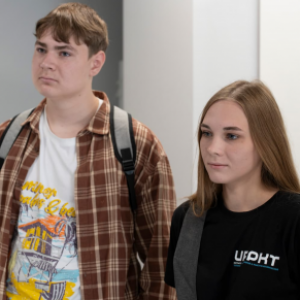
Under the umbrella of the Space-π research project by the Innovation Promotion Foundation, an introductory visit was organized at the production facility of STC LLC (Special Technological Center). The delegation included Olga Zhaldybina, a process engineer at Samara University’s Advanced Aerospace Engineering School "Integrated Technologies in the Creation of Aerospace Equipment," and Evgeny Rozhkov, a 10th-grade student and lead executor of the project "Assessment of the Relationship Between the Earth's Magnetic Field and Radio Wave Propagation in a Wide Frequency Band."
Evgeny Rozhkov’s project focuses on studying how the geomagnetic environment affects radio signal propagation across a wide frequency spectrum. The plan is to integrate student-developed equipment onto a 3U CubeSat small spacecraft (SC) platform. This payload will assess the state of the Earth's magnetic field over specific territories while simultaneously measuring electromagnetic radiation levels across a broad frequency range. By collecting, processing, and analyzing this statistical data, the team aims to predict radio communication stability in targeted regions based on varying levels of magnetic disturbance.
During the visit to STC LLC, Olga Zhaldybina and Evgeny Rozhkov were given a close-up look at 3U CubeSat satellites. Special emphasis was placed on the design specifics of the onboard radio-technical equipment. Furthermore, the delegation toured the Flight Control Center, where they observed the real-time processes of spacecraft management, as well as the reception and processing of telemetry data.
"To successfully implement this project, it is crucial to understand how the reception and processing of radio signals from CubeSats are organized in practice. By observing the operations of the Flight Control Center and the physical design of the satellite's onboard equipment, the students involved in the project can refine their methodology for assessing the Earth's magnetic field's impact on radio wave propagation. This is an invaluable experience for them, as it bridges the gap between theoretical models and real-world engineering solutions," noted Olga Zhaldybina.
This introductory visit served as a vital practical phase of their research. It enabled the Space-π project participants to align their theoretical knowledge with the actual technical solutions currently deployed in the Russian space industry. The insights gained will be directly applied to the ongoing development of the project.
For Reference:
This initiative is organized under the Space-π scientific and educational project by the Innovation Promotion Foundation, which aims to engage schoolchildren and university students in scientific, technical, and research activities within the space technology sector. The project is supported by the "Personnel for Space" federal project of the Russian Ministry of Science and Higher Education.
