

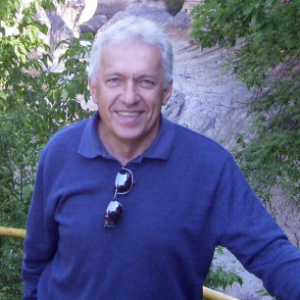
In 2026, the British publishing house Taylor & Francis Group released Professor Vladimir S. Aslanov's book, "Advanced Mission Scenarios of the Three-Body Problem."
The professor's research focuses on the orbital dynamics of planets and moons, and how their gravitational interplay dictates space mission design. Specifically, Vladimir S. Aslanov explains how to deploy tether systems for various applications, how to clear space debris from operational orbits, and how to guide spacecraft during planetary descent.
The Three-Body Problem
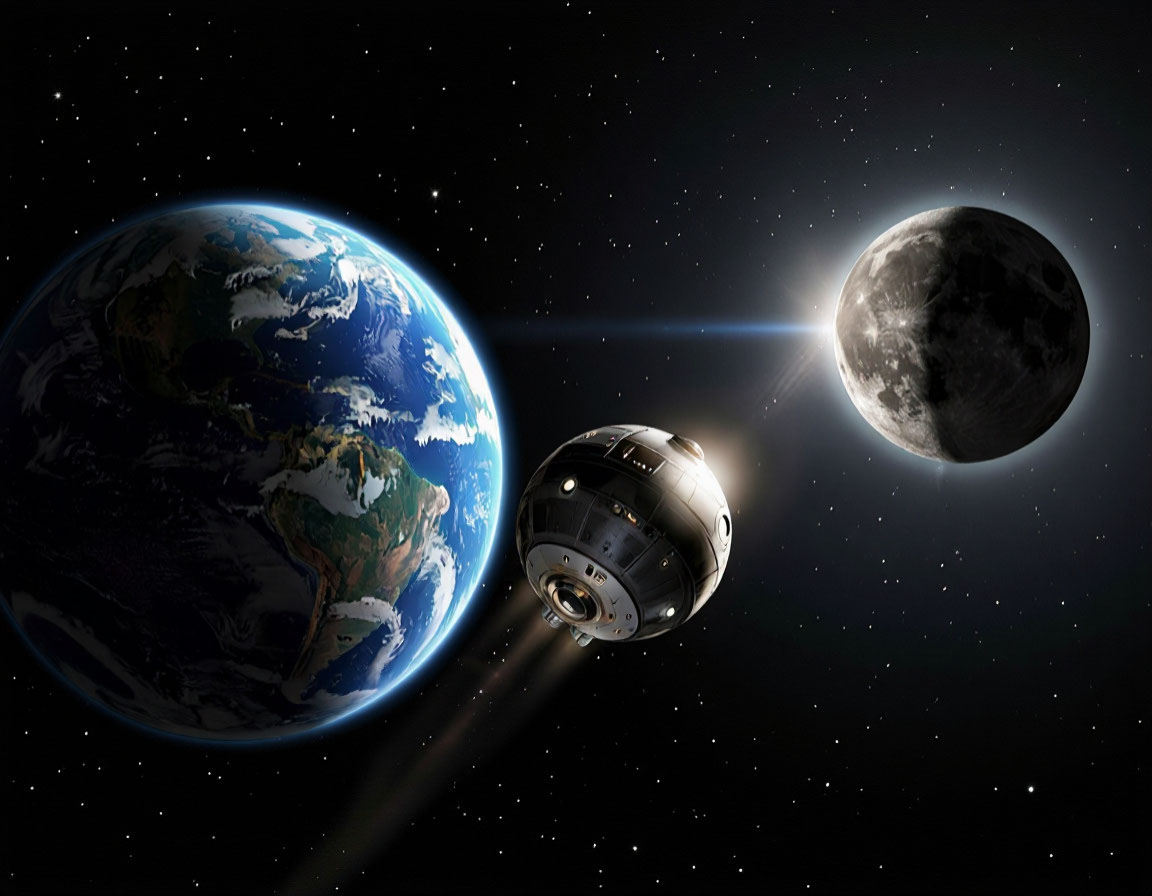
"The book explores the gravitational influence of two massive celestial bodies—such as the Earth and the Moon, or Mars and Phobos—on a spacecraft. In this scenario, the spacecraft is the 'third body,' and its trajectory can be calculated using mathematical models that account for the pull of the planets and their natural satellites.
Traditionally, trajectory calculations account for Earth's gravity up to a certain boundary in space, after which the Moon's influence takes over. But this is flawed! Even when a spacecraft is primarily under a planet's gravitational dominance, the Moon's pull still acts upon it. Yes, it's weak, but factoring these forces into our calculations allows us to adjust the trajectory, saving fuel or cutting down flight time. This is known as the 'restricted three-body problem,' as we ignore the spacecraft's own mass.
When we leave the Earth-Moon system—for instance, heading to Mars—we must also factor in the Sun's gravitational pull in our equations. Yes, our star is far away, but its mass is so immense that ignoring it during interplanetary travel is a terrible idea. In this case, we are actually dealing with a four-body problem!"
Maneuvers and Halo Orbits
"Spacecraft never fly directly to their targets. They maneuver because, in a 'planet-moon' system, the spacecraft is pulled by two bodies, not one. Furthermore, we must account for the fact that the Moon orbits the Earth (well, technically, they both orbit their common center of mass, which doesn't always align with the planet's physical center). And the entire system is rotating. This generates centrifugal force, which constantly tries to tear the gravitational bond between the planet and its satellite apart.
So, we have three distinct forces acting on the spacecraft. This complex interplay creates intricate trajectories known as 'halo orbits'—periodic, three-dimensional paths around Lagrange points, which are points of gravitational equilibrium or libration.
Maneuvers that account for all these cosmic forces are calculated long before a ship is launched into orbit. But are these calculations thorough enough? Can they be optimized? Are there alternative trajectories? These are the questions I strive to answer in my book. In the process of solving these celestial mechanics puzzles, I propose solutions for a range of highly relevant space missions."
Geostationary Orbit and Global Communication
"If you launch a satellite to the altitude of the International Space Station—about 400 km—it will orbit the Earth in 1.5 hours; that is its orbital period. The higher the altitude, the longer the period. At an altitude of 36,000 kilometers lies the Geostationary Orbit (GEO): it sits in the equatorial plane (perpendicular to the planet's axis of rotation). Here, the orbital period matches the Earth's rotation—exactly 24 hours. This orbit allows us to position just three satellites to provide humanity with global communication coverage for almost the entire planet, excluding only the polar ice caps.
All slots in these orbits are allocated and strictly regulated by international agreements. In essence, when countries place telecommunications satellites at these altitudes, they are leasing orbital real estate."
Where Does Space Debris Come From?
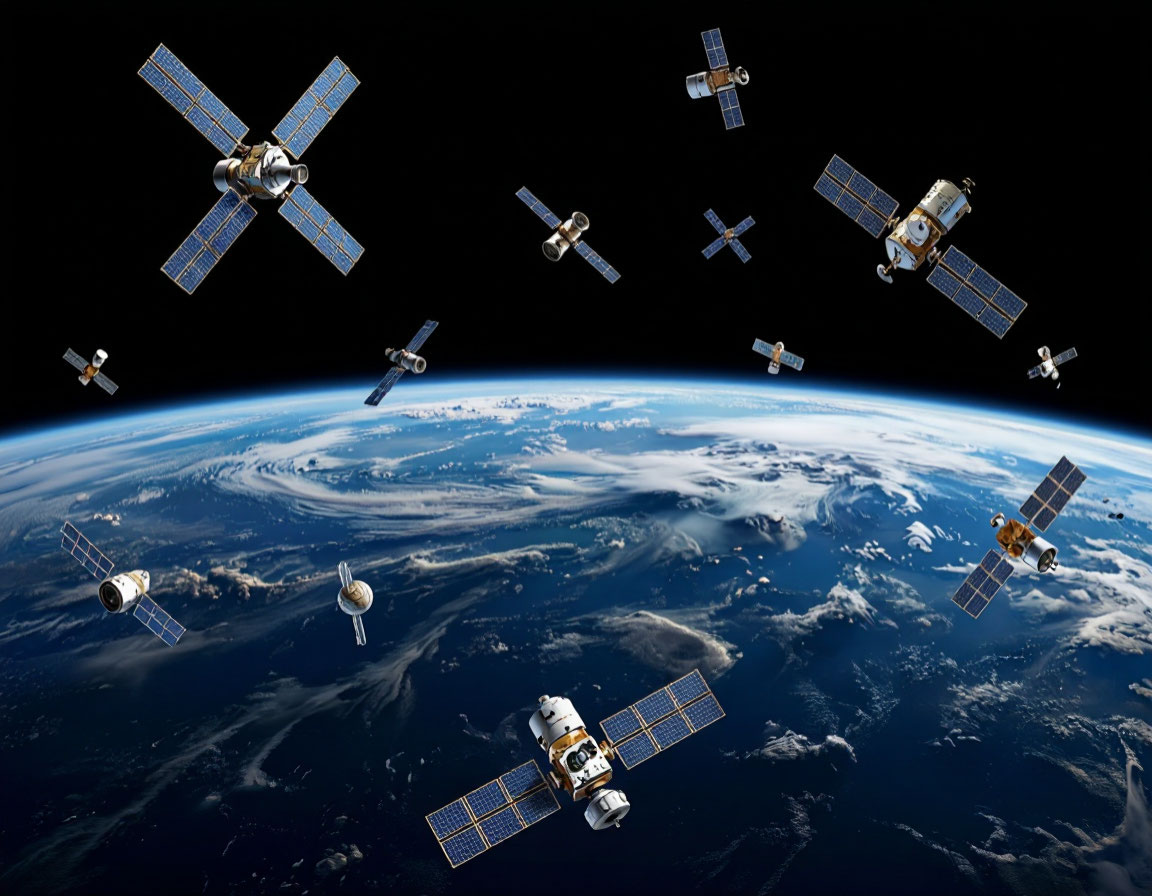
"How much debris is currently in orbit—spent rocket stages, dead satellites, fragments? The American NORAD system—a unique tracking and prediction network—monitors the location of 27,000 space objects measuring 10 centimeters or larger. This system knows what is up there, where it's going, and when it will fall.
Now, let's look at the mass distribution: 4,000 tons of space debris are located near the ISS orbit, and another 2,500 tons are in geostationary orbit. Why? Because GEO is home to massive satellites, weighing between 3 and 6 tons each. The most common 'residents' are American Intelsat satellites (manufactured by Boeing). There are about 500 of them up there. They are launched with a 15-year lifespan. Like any machine, they eventually fail and break apart. Two years ago, Intelsat-33e broke up. As a result, the zone it 'seeded' with fragments is lost for spacecraft placement forever: these fragments aren't going anywhere; they will remain there eternally, as the retention time in GEO is essentially infinite.
Now imagine if more of these 'closed' zones appear. At some point, we simply won't be able to launch a single ship into the unique geostationary orbit. Humanity would be cut off from the space technologies we take for granted: communications, the Internet, scientific research. We would have to forget about deep space exploration."
How to Clean Up Low Earth Orbits
"In low Earth orbits, we propose using tether systems: a conventional chemical-propulsion spacecraft flies up, fires a harpoon or casts a net, and drags the debris into the dense layers of the atmosphere to burn up or crash to Earth. This method is ideal for clearing massive rocket stages—each can be several meters in diameter and weigh several tons. There are thousands of these behemoths in orbit; rockets were launched not only by the USSR and the US but also by many other nations. Yes, if even one of them breaks apart, it creates a cloud of tiny fragments that are incredibly difficult to clean up.
Why is this so dangerous? Back in 1978, astrophysicist Donald Kessler hypothesized that the increasing number of launches into low orbits would lead to more frequent collisions and the destruction of large objects, triggering an avalanche-like growth of space debris. Consequently, certain orbital regions would become unusable. This phenomenon is known as the Kessler effect or Kessler syndrome. Today, as thousands of Starlink, Chinese Guowan, and Sanjiang satellites are launched into these exact orbits, this scenario is becoming increasingly probable."
Geostationary Orbit: The Problem and a Unique Experiment
"Now let's move up to geostationary orbit. A tug with a tether won't help here: a launch vehicle like the Proton, with a liftoff mass of 800 tons, can deliver a payload of at best 3 to 4 tons to GEO, including fuel, nets, and harpoons. Yet it would have to tow heavy satellites back toward the planet. It's an unsolvable task.
Therefore, we need an economical scheme. In GEO, satellites aren't brought down; they are pushed 200 km higher into a graveyard orbit—a sort of spaceship cemetery.
So far, there has been only one such experiment. The Americans moved an Intelsat satellite. These satellites operate for a long time and require constant power, so they are equipped with massive solar panels and engines. The experiment involved docking another, still-active satellite to the Intelsat's nozzle, which then pushed its 'comrade' higher. But this isn't a scalable solution: the 'tug' couldn't return. It was a one-way ticket.
So, we are looking for fundamentally different approaches."
Ion Beam Transportation
"Currently, spacecraft are equipped with chemical rocket engines running on kerosene and oxygen. Their exhaust velocity maxes out at 3 km/s.
We propose replacing them with electric propulsion engines, where the primary energy source is solar panels that feed voltage to a magnetic coil: gas ions are accelerated in the core by electricity and ejected at tremendous speeds—up to 60 km/s. For such engines, the mass of the propellant required is 20 times less than for chemical ones.
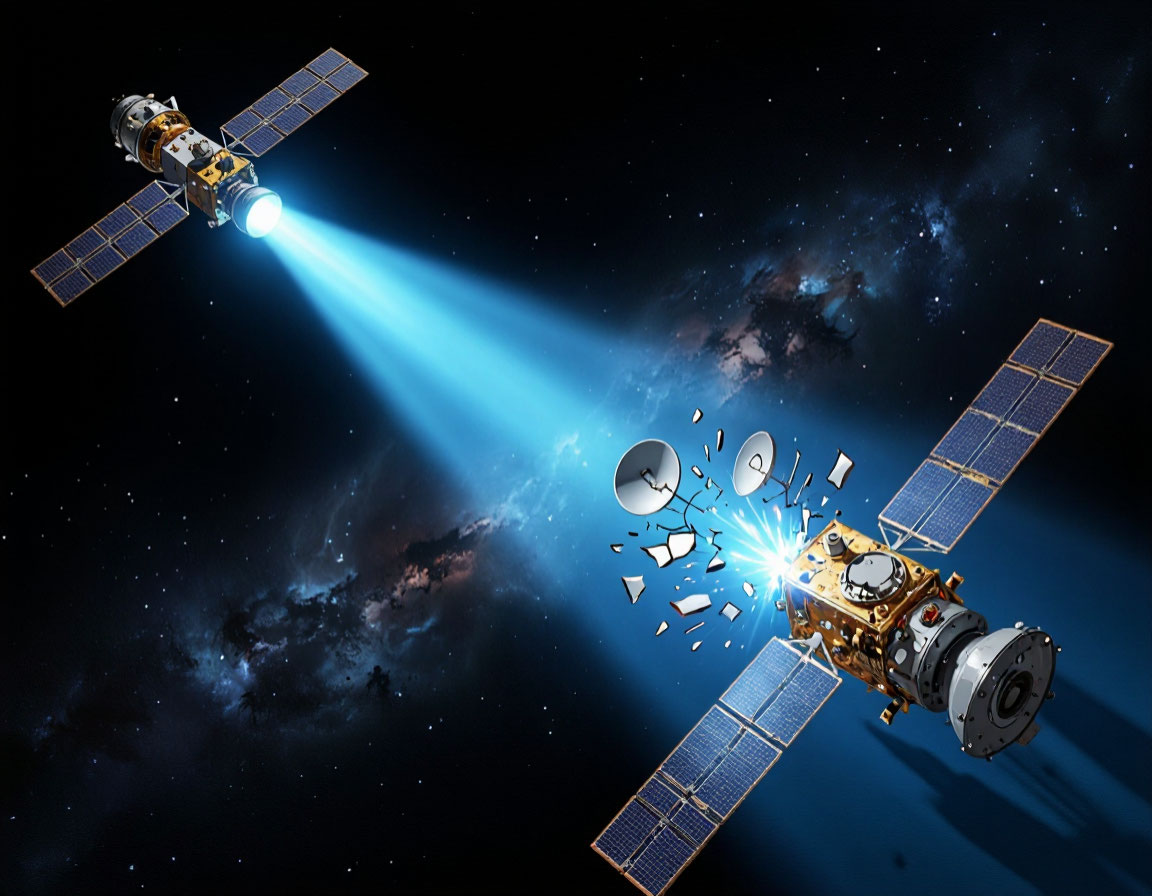
This opens up a new method for debris removal: ion beam transportation. An active spacecraft turns on its ion engine, creating a sort of plasma torch that 'blows' the debris away. Using its main thruster, the 'cleaner' spacecraft holds its position and pushes the target object off its orbit without ever physically touching it.
My student, who is now a colleague, Alexander Ledkov, and I took this idea a step further: using the ion beam to flip the debris into a different plane, thereby increasing the surface area exposed to the thrust. This concept was awarded a Russian Government Mega-Grant in 2019, and in 2022, Elsevier published our book, “Attitude Dynamics and Control of Space Debris During Ion Beam Transportation”.
Such an ion-powered space 'street sweeper' would be useful not only for orbital clean-up days but also as a satellite rescuer. For example, it could use an ion beam to adjust the orbit of an operational satellite, extending its lifespan. Or it could solve the problem of injection errors—if a satellite is placed into the wrong orbit, the 'rescuer' can help the stranded craft reach its intended destination."
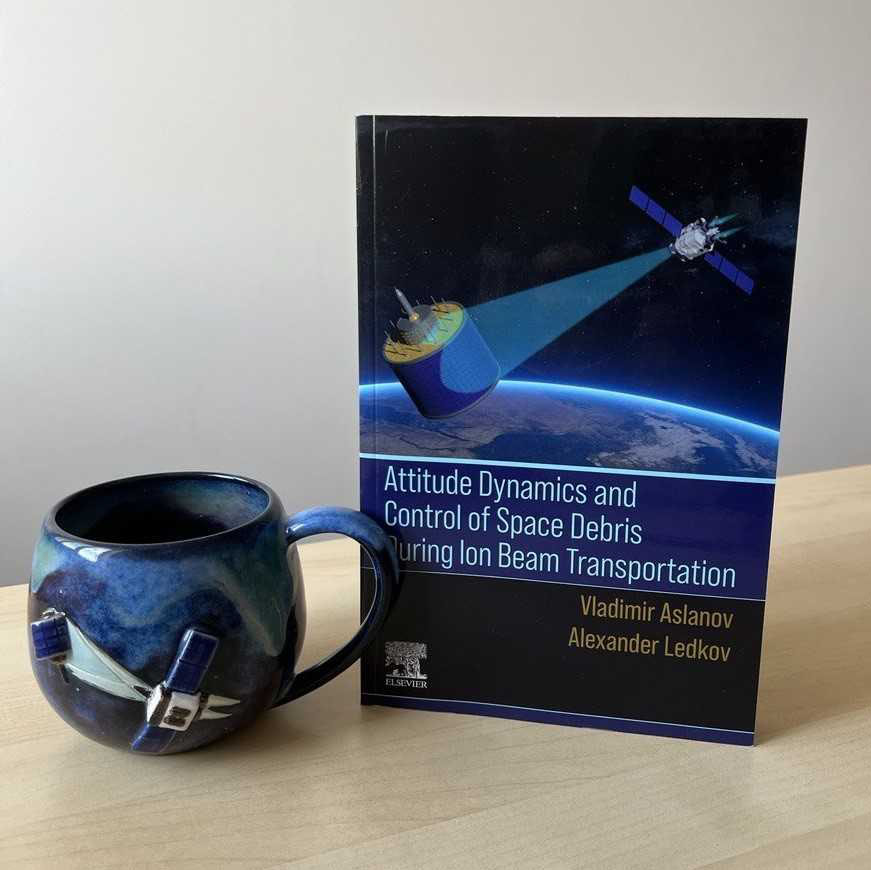
In Vladimir S. Aslanov's cabinet, a place of honor is held by a gift from a colleague, Danila Ivanov, an associate professor at MIPT (Moscow Institute of Physics and Technology) and a master potter: a mug featuring a drawing of a contactless space debris tug. "It's a great gift!" says the professor. "I have dedicated nearly a quarter of my life to the topic of orbital cleanup, and with each passing year, I become more convinced that this is a paramount task for humanity."
Coulomb Interaction
"There is another contactless method for nudging defunct space objects off their orbits: Coulomb interaction. It's like a school experiment: a comb attracts hair, but it can also repel it. Under certain conditions, space debris becomes electrically charged (influenced by the Sun) up to 20 kilovolts. If we generate the same charge (20 kilovolts) on the tug, it will repel the fragments off their orbit. The electricity comes from solar panels, making it highly economical. If the Sun isn't 'working,' we can use an ion beam to give the debris a positive charge, surround the cleaner spacecraft with a positive charge as well, and push the debris away through electrostatic repulsion."
Gravitational Collector
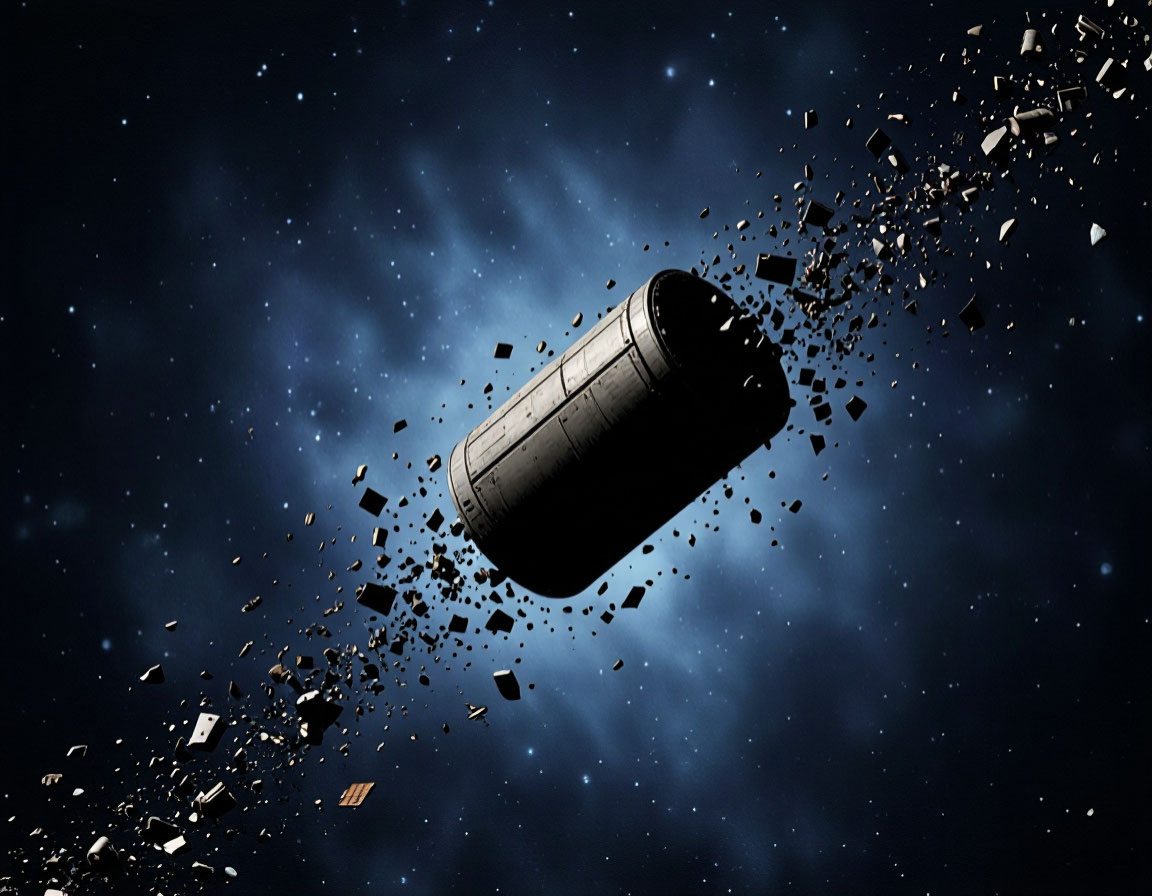
"But how do you gather a swarm of fragments if two large telecommunications satellites collide in geostationary orbit? We need to create an artificial moon in this orbit—weighing up to 100 tons—which, through its own mass, will generate a gravitational field to attract small fragments, divert them to the graveyard orbit, and then 'shake them off' by rotating or altering its charge. Essentially, it's a gravitational collector. Imagine the scenario: an Intelsat satellite breaks apart; the 'Moon' approaches the area and acts like a vacuum cleaner, pulling everything toward it.
Why is 100 tons not a problem? Because launching massive modules is already a proven capability: the ISS weighs 400 tons. Alternatively, the artificial moon could be an asteroid: we catch a 'rock' the size of a nine-story building, tow it into geostationary orbit, and suddenly we have a significantly larger capture radius.
We propose building the gravitational collector in the shape of a vertical cylinder to increase the capture area. It would be equipped with low-thrust engines to allow it to transition to the graveyard orbit and return for the next batch of debris.
According to one of our model scenarios, the debris collected by the satellite can be accumulated around it, thereby increasing the collector's useful mass and enhancing its gravitational pull."
Space Elevators: And What Does Phobos Have to Do With It?
"The concept of the space elevator was conceived by Konstantin Tsiolkovsky and developed in the 1950s by an ordinary engineer from Leningrad, Yuri Artsutanov. The whole world caught fire with the idea. The scientist and sci-fi writer Arthur C. Clarke visited Yuri in Leningrad. Following that meeting, his novel The Fountains of Paradise was published. But the idea never progressed beyond fantasy: we still cannot step into an elevator cabin and ride it to orbit.
The issue is that in the Earth-Moon system, a space elevator would need to be 110,000 kilometers tall. If built from the Moon, it would need to be even longer, as the Lagrange point is 150,000 kilometers away. These are colossal dimensions, demanding materials and structural integrity we don't yet possess. Why? For a space elevator to be maximally stable and reliable, the center of mass of the tether system must be located at one of the Lagrange points. In these special points in space, various physical forces so successfully compensate for each other's mutual influence that a small object placed there experiences a sort of gravitational 'weightlessness' or equilibrium—it is pulled neither toward one massive rotating body nor the other (e.g., Earth-Moon or Mars-Phobos).
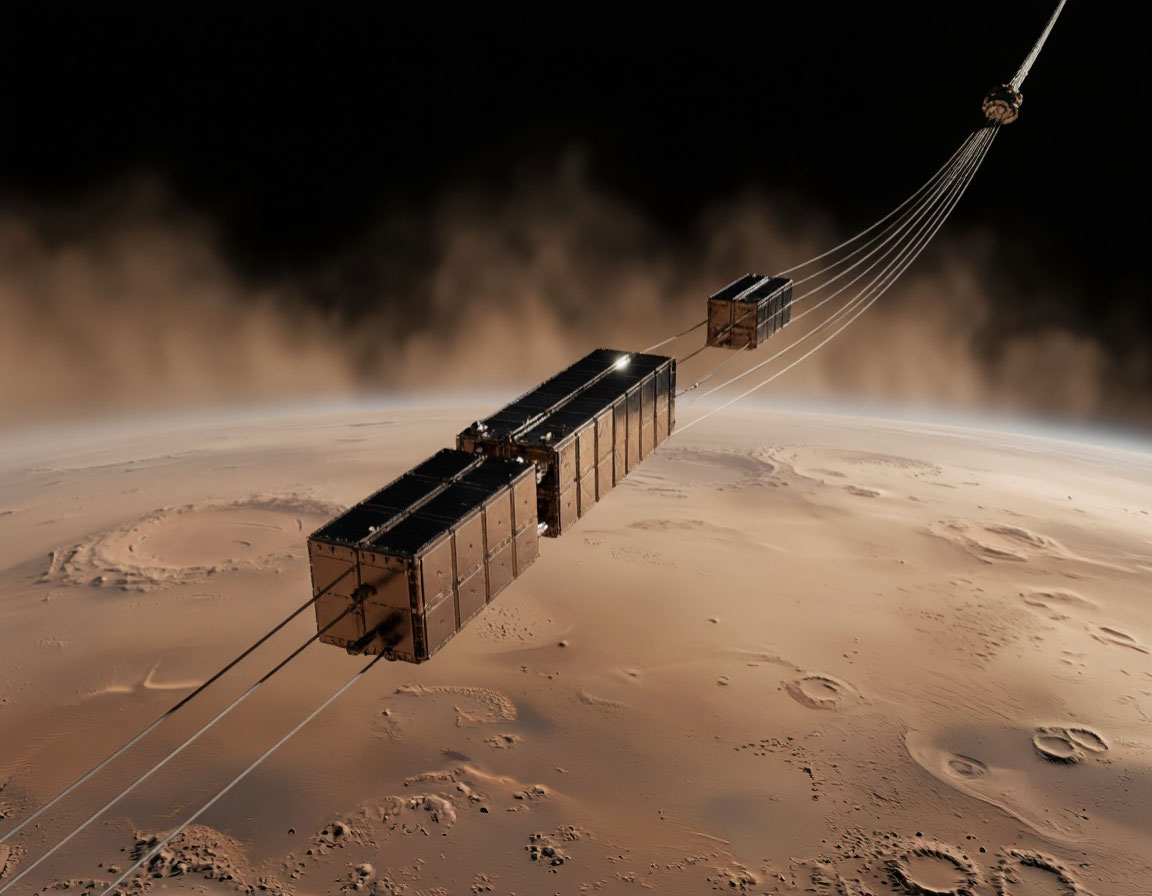
Now let's look at the Mars-Phobos system. Mars is similar to Earth, but its gravity is weaker. Phobos is an irregularly shaped rock, 25 kilometers across. The acceleration of gravity on Phobos is 200 times less than on Earth; effectively, there is no gravity. And most importantly: the distance between the surfaces of these two bodies is only 6,000 kilometers! Compare that to the 386,000 kilometers between the Earth and the Moon. The Lagrange point, which dictates the elevator's length, is just 3.4 km from Phobos! Building an elevator here is a breeze. As a reminder, in 2007, the European Space Agency, together with the Samara-based Progress company, conducted the YES2 (Young Engineers' Satellite 2) experiment, deploying an 8-kilometer tether in orbit. Scientists from Samara University participated in preparing this experiment."
The Hovering Space Elevator
"So, creating an elevator from Phobos toward Mars is not a problem. What for? Such a structure would allow us to study Mars at a fraction of the cost. For example, we could lower equipment and sensors on a special tether from a spacecraft stationed at the Lagrange point. On the other hand, we could plan transfer trajectories using impulsive maneuvers and space tether systems to deliver a payload from the surface of a planet's natural satellite down to the planet itself.
In my book, I introduced a new concept: the 'hovering space elevator.' Why 'hovering'? Even if the elevator cabin is located at an altitude of 5 km, 100 km, or 6,000 km, it doesn't change the fact that the entire 'planet-satellite' system is rotating. This rotation creates centrifugal forces. In the Phobos-Mars system, the equilibrium point is at a distance of 3.4 km. Above the Lagrange point is the terminal station of the space elevator from Phobos. We get a transport corridor: we deliver soil samples from Phobos to this point, a spacecraft flies here, loads up, and departs for Earth. But if a probe is released from the terminal station toward Mars, it will fly without engines—it will be pulled by the planet's gravity. This results in a hovering space elevator. It 'rises' (from Phobos's perspective) or 'descends' (from an observer on Mars) purely due to gravitational and centrifugal forces.
This is entirely possible in the Earth-Moon system as well.
If a cabin is attached to the station by a tether, it can monitor the planet's surface; if the tether is detached, the cabin (or payload) descends to the planet's surface. This allows for cargo delivery without using a single drop of fuel."
Tethers for Studying Phobos
"In 2026, the Martian Moons eXploration (MMX) mission is scheduled for launch. The robotic MMX spacecraft will land and collect samples from Phobos, observe Deimos during a flyby, and monitor the Martian climate.
The spacecraft will fly in quasi-satellite orbits because Phobos—the primary target—is not a proper moon, but rather a flying rock. The spacecraft will fly very low—just 10 kilometers above the surface. Then, a rover of sorts, a 'phobomobil,' will be dropped to collect soil and return to the ship. Samara scientists propose that the mission authors add a tether with an instrument package at the end. Adjusting the tether's length is easy, and as a result, the instrument can scan Phobos's terrain at an altitude of just 50 to 100 meters. This will allow us to gather vastly more information about the surface of this satellite.
By the way, the Roscosmos State Corporation has announced the 'Boomerang' mission (Phobos-Grunt 2—an automatic interplanetary station), which also aims to study the Martian moons, with a launch planned for after 2030. Tethered sensors could find application here as well."
A New Two-Impulse Transfer Scenario
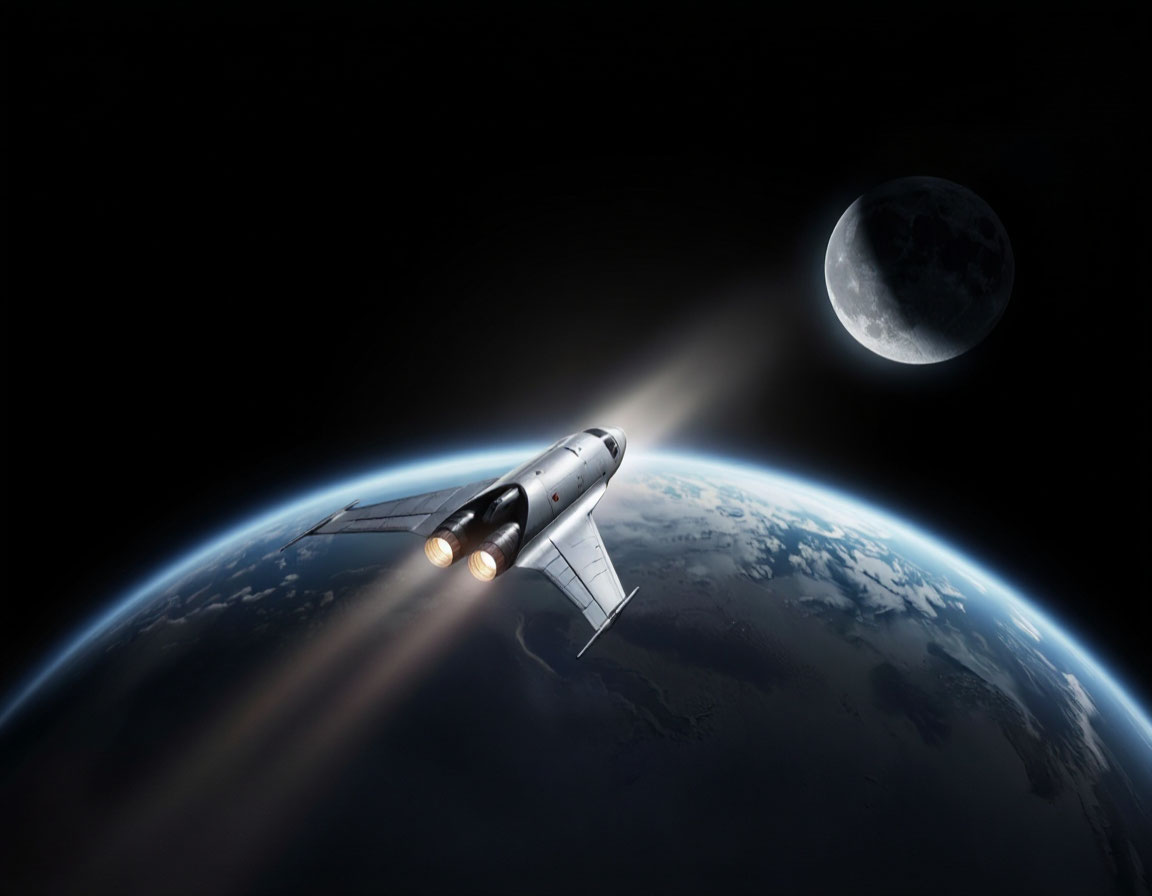
"Here, the task of transporting cargo from a satellite to a planet reaches a new level. Today, the most critical transport corridor is the Moon-Earth route. Currently, the return trajectory from our natural satellite looks like this: a ship launches from the Moon; to overcome lunar gravity and enter lunar orbit, the rocket engine fires, then a second impulse is given, and the ship flies toward Earth.
We propose utilizing Lagrange points during the flight. We fire the launch engine, accelerate, and calculate the trajectory. We launch, selecting the necessary angle and thrust to arrive at the point of free fall, just like in the 'hovering elevator.' At this point, the spacecraft's relative velocity must equal zero. To achieve this, a second impulse is applied, this time using a low-thrust electric propulsion engine (whose exhaust velocity is 20 times higher), but in the opposite direction, causing braking. The ship 'stops,' after which it enters free fall and controllably drops toward the desired point on the planet. This scenario is fast, quite economical, and also serves as an excellent backup for emergency situations.
As a result, the mission uses exponentially less precious fuel for the chemical engine. The mass of the spacecraft itself also increases. For example, for a one-ton spacecraft, a chemical engine would deliver half a ton of payload, whereas with low-thrust electric propulsion, it could deliver 750–800 kg."
The Rescue Point and Alternative Transfer
"Now, let's revisit the story of the Apollo 13 rescue. In that American lunar mission, an oxygen tank exploded. The chances of survival were close to zero. The ship was flying in a 'figure-eight' pattern, and ballistic scientists somehow managed to calculate where to direct the braking impulses (there were many of them) so the ship would land at a designated point. Since then, this 'figure-eight' has been the standard route.
We believe that for this 'figure-eight,' we can organize a 'point of extreme rescue,' where the spacecraft's relative velocity must be zero. This point would be universal; a dedicated rescue team could be pre-positioned for it. It's a sort of alternative transfer. Such a point can be calculated and programmed into the flight plan right now."
About the Book, the Publisher, and the Reviewers
"At the core of each chapter of this book are articles published in Q1-tier journals, yet the book offers a holistic view of the modern problems of celestial mechanics. A monograph like this allows the theme to be formulated as comprehensively and voluminously as possible. Moreover, when an author processes their accumulated experience while writing a book, a unified approach emerges.
Taylor & Francis Group is a British publishing house headquartered in New York, ranking in the top three for citation indices in the scientific community. The publisher is distinguished by its approach to scientific literature: they require five reviewers, three of whom are Americans—all renowned scientists and global leaders. Secondly, the author isn't even provided with a PDF version of the book, only five physical paper copies. Thirdly, the contract essentially includes a 'right of first refusal': before the author decides to publish their next book elsewhere, they are obligated to first offer it to the editors at Taylor & Francis Group. Only if they cannot agree on publishing terms can the author go to another publisher. But the author hasn't tried how that works yet!
I must note the speed of the decision to publish the book—it was practically instantaneous: 'Yes! Send the manuscript!' More than that, at the moment the monograph was already accepted by the publisher, a new twist on the topic occurred to me. The publishers added another chapter to the book. And, fortunately, this new material was quickly published in the journal Aerospace Science and Technology while the publishing house was working on the book."
Text: Elena Pamurzina
Photo: Olesya Orina
Illustrations created using the Alice AI app
