
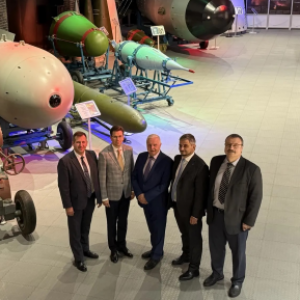
A high-level joint meeting dedicated to advancing scientific, technical, and educational cooperation was held in Sarov at the Russian Federal Nuclear Center – All-Russian Research Institute of Experimental Physics (RFNC-VNIIEF). Participants identified key areas for collaboration, focusing on unmanned aerial systems (UAS), artificial intelligence, engineering software, and photonic computing systems.
A Joint Vision for High-Tech Innovation
Samara University was represented by a heavyweight delegation:
- Viktor Soifer, Academician of the Russian Academy of Sciences (RAS) and University President;
- Ivan Tkachenko, Director of the Institute of Aerospace Engineering and the Advanced Aerospace Engineering School;
- Artem Nikonorov, Director of the Institute of Artificial Intelligence and the World-Class Research Center "Intelligent Unmanned Aerial Systems";
- Roman Skidanov, Leading Researcher at the World-Class Research Center "Intelligent UAS";
- Maxim Borisov, Head of the Digital Factory for Regional Aviation and UAV Systems at the Advanced Engineering Aerospace School.
The host institution, RFNC-VNIIEF, was represented by Rashit Shagaliev, Deputy Director for Priority Technological Development and Corresponding Member of the RAS, alongside heads of research divisions Dmitry Linnik, Andrey Kozelkov, and Ksenia Ermoshkina.
Key Presentations and Strategic Alignment
The business program featured a series of targeted presentations outlining the future of this partnership:
- Maxim Borisov presented Samara University's comprehensive development program for unmanned systems, highlighting it as the cornerstone for personnel, scientific, and technological cooperation.
- Artem Nikonorov detailed the initiatives of the Institute of Artificial Intelligence, emphasizing a strategic shift from fundamental research to applied, industry-ready solutions.
- Ivan Tkachenko outlined the university's approach to training specialized personnel to meet the specific needs of RFNC-VNIIEF.
In turn, representatives from the nuclear center reported on the current status and future plans for integrating the "LOGOS" software suite into university curricula, as well as ongoing joint efforts in developing software for mathematical modeling and engineering analysis.
A dedicated session focused on photonic computing systems. Dmitry Linnik presented the current landscape and joint project plans, while Roman Skidanov discussed bridging the gap between scientific groundwork and practical, real-world applications.
Looking Ahead
The meeting concluded with an in-depth discussion of promising avenues for collaboration. Both sides reaffirmed their strong mutual interest and shared a clear commitment to launching joint projects that will drive the development of Russia's high-tech industries.
By uniting the academic prowess of Samara University with the technological might of RFNC-VNIIEF, this partnership is poised to deliver breakthrough innovations in aerospace, AI, and next-generation computing.
