

A PhD student from Samara University has highlighted the university’s growing role in global high-energy physics by presenting advanced theoretical research at the inaugural Physics of Particles at Medium and High Energies (PPIHE-2026) conference.
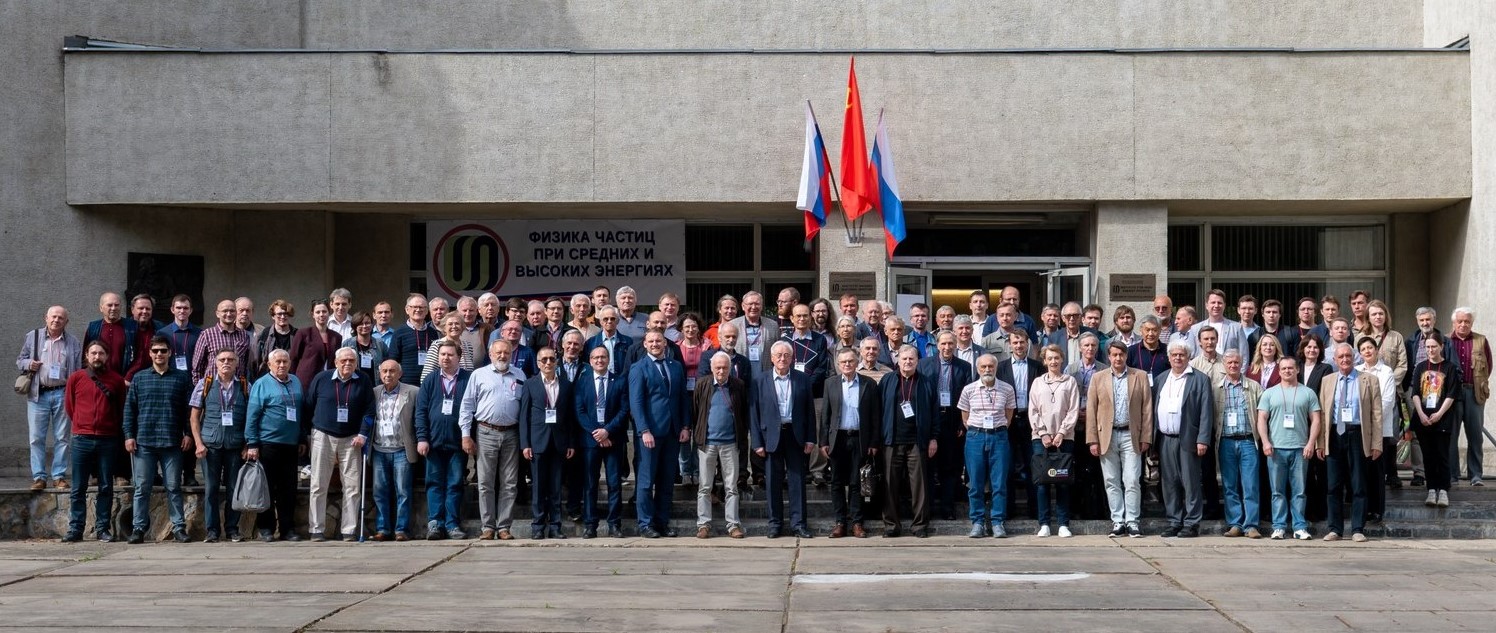
Held from June 2 to 5, 2026, in Protvino, Moscow Region, the prestigious event was hosted by the Theoretical Physics Department of the A. A. Logunov Institute for High Energy Physics (IHEP). The conference served as a major platform for discussing the latest theoretical and experimental breakthroughs in the field of particle physics.
A Gathering of Leading Minds
The plenary sessions featured keynote addresses from Russia's top physicists, including:
- M. G. Ryskin (Petersburg Nuclear Physics Institute) on "Search for the QCD Instanton";
- A. V. Kotikov (Joint Institute for Nuclear Research, JINR) on "Analytic Coupling Constant in QCD";
- S. R. Slabospitsky (IHEP) on "Main Research Directions at the Proton Accelerator up to 1 TeV";
- O. V. Teryaev (JINR) on "Non-perturbative QCD and Spin Asymmetries: A Theoretical Review".
Discussions spanned a wide array of complex topics, including quantum chromodynamics (QCD), non-perturbative and spin effects, hadron spectroscopy, relativistic nuclear physics, and rare decay processes.
A significant portion of the conference was dedicated to reviewing the current status, technical readiness, and future experimental plans for Russia's major accelerator facilities. Presentations covered the U-70 accelerator complex in Protvino (featuring the SPASCHARM, OKA, and VES experiments), the VEPP-2000 electron-positron collider in Novosibirsk, the SPD and MPD detectors at the NICA collider in JINR, as well as the U-1000 proton accelerator project in Protvino and the HiptaN experiment at JINR. Additional research was showcased during dedicated poster sessions.
Samara University at the Forefront of Spin Physics
In the specialized section dedicated to spin effects in strong interactions, Kirill Shilyaev, a PhD student at Samara University’s Department of General and Theoretical Physics, delivered a highly regarded presentation titled "Lepton Angular Coefficients in J/ψ Production in the Soft Gluon Resummation Approach."
His research, supervised by Professor V. A. Saleev, Doctor of Physical and Mathematical Sciences and Head of the Department, explored the impact of gluon polarization within unpolarized protons. Utilizing Boer-Mulders gluon parton distribution functions, the study analyzed how this polarization affects the polarization of produced J/ψ mesons and the angular distribution of their leptonic decays.
Crucially, Shilyaev presented calculation results specifically tailored for the future SPD NICA experiment. Samara University has been an official member of this international collaboration since 2021, contributing significantly to its theoretical and computational framework.
Looking Ahead
The conference successfully brought together the nation's top minds in high-energy physics, fostering collaboration and setting the agenda for future experiments. Following the event, the conference proceedings—including the Samara University team's contributions—will be published in the SCOPUS-indexed journal Physics of Atomic Nuclei.
Through active participation in premier forums like PPIHE-2026, Samara University continues to solidify its reputation as a vital hub for fundamental physics research and the training of the next generation of world-class scientists.
