

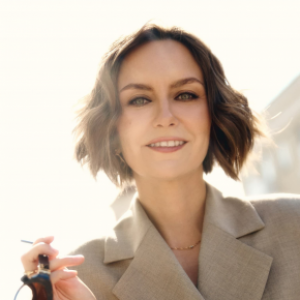
Daria Timoshina, Candidate of Philological Sciences at Samara University, is certain: when words like this enter our vocabulary, it means technology is no longer something distant to us. In an interview with sobaka.ru, she discusses why the universal use of the word "cringe" poses a danger to language, how a casually dropped phrase can reveal all our "passwords and secret locations," and why it is sometimes useful to recalculate your personal route (especially if it feels like you've gone off track!).

"I'm not against slang. I just don't want it to invade all spheres of communication"
— Have you noticed that students perceive female instructors differently?
— Not in any particularly special way. However, there is one factor that I think has a slight influence: appearance. In the first few classes, students assume I am only slightly older than them and quite lenient. Probably because, for me, a lecture is not a monologue: we communicate, we can digress from the topic, and discuss things. Therefore, the students feel confident that I might give in somewhere, and they relax. Even though I am actually very demanding.
— Do you understand freshman slang? Do you speak it?
— It feels strange when an instructor, in an attempt to show they are "on the same wavelength" as students, starts using such words. I am not against slang. I just don't want it to invade all spheres of communication. For example, when the word "cringe" is used instead of literally any other word. Yes, it might convey information faster, but deeper meanings can be lost...
— And what trendy word do you like the most right now?
— Probably the word "vibe": it somehow sets the right mood. However, you can hardly call it modern slang anymore (it's been around for about seven years!).
"There is a stereotype in society that humanities research is something unserious"
— What scientific developments have you had recently? What are you particularly proud of?
— My first major "challenge" was my dissertation on the history of the Russian language, where I studied the development of the root -serd- (heart). This topic was a continuation of the research I had been doing as a student. I have always been active in science: I traveled to Moscow and St. Petersburg for conferences, and then I wondered why we shouldn't organize something similar here. Our first conference gained all-Russian status and is still alive! This May, it was held for the 16th time.
I am also glad to be involved in educational outreach projects. Since 2018, we have been hosting the "Universum" competition for schoolchildren at Samara University. There, I act not only as a philologist but also as an organizer and producer. I also try not to abandon my scientific activities. I research neologisms—the new words that appear in speech. For example, in 2023, "neural network" became the Word of the Year in Russia. I became curious if there were any derivatives. It turns out there are: "neuro-baby","neuro-network-ness", and "neuro-networky". If a person uses diminutive suffixes, it means modern technologies no longer scare them.
— How is the success of a philologist measured, given that their work cannot be physically touched?
— The result can be expressed in the form of publications. There is a stereotype in society that humanities research is something unserious. In reality, it is work with meaning. I want people to come to this understanding.
Philologists, by the way, hear more in everyday speech than others: they notice atypical pronunciation or unusual intonation. You can understand where a person is from, what their profession is, and how old they are. We simply do not notice many speech peculiarities in ourselves. When I went to Moscow for the international "Lomonosov" conference, the professors immediately understood that I was from the Volga region: they noticed that I slightly draw out the [a] sound.
"My superpower (and simultaneously my pain!) is my passion"
— Which character trait often becomes your superpower? And which one, on the contrary, gets in the way?
— My superpower (and simultaneously my pain!) is my passion. Even if a topic is not close to me, I will still find something to latch onto. However, this trait sometimes greatly complicates life. At work, I cannot tolerate formalism and I am bad at delegating responsibilities. And also—at telling myself "stop" in time.
— Has there been a woman in your life whose example influenced you the most? What exactly did you adopt from her?
— My mother is a lead design engineer working in the aerospace industry. She has dedicated her whole life to it, even though it seems like a male-dominated field—hierarchical and strictly subordinated. She manages to feel completely organic in it, and she cares deeply about her work. My mother passed this trait on to me.
"A Woman's advantage lies precisely in the fact that we have the right to choose"
— Today, it seems society expects the impossible from women: to be successful, calm, caring, and productive. In your opinion, what is that very "female power"?
— A woman's advantage lies precisely in the fact that we have the right to choose: our own path, pace, and priorities.
— Do you have a small ritual that helps you not to "dissolve" in work, relationships, and the daily grind?
— I understand that I need one, but I am still searching. Fatigue especially accumulates towards the end of the academic year—it feels like a "burnt field" inside. In such moments, I want to quit and work strictly from nine to six. Although those who know me well say I wouldn't be able to exist in such a mode: it would become boring. Perhaps I will try it someday! Or I will (finally!) learn to find time for myself, my family, and something else. Simply to relax and read a book.
— Has there been a work of literature that appeared in your life at the most needed moment and even changed it?
— Last summer, I discovered a book by Maria Buras about Andrey Zaliznyak, a renowned Russian linguist. The book is titled "Truth Exists" (Istina sushchestvuyet). This is part of a phrase belonging to the scientist, and its continuation is: "And the goal of science is to seek it." This is the very principle we are guided by in our activities.
Contemporaries recalled that Zaliznyak possessed a genuine love for language. And this feeling manifested in everything he did. When you work for a long time, research and pedagogical interests get "buried" under a pile of reports. In this flow, you forget the main thing: what you are doing is your beloved vocation. I literally "devoured" this book while flying on a trip, and now I recommend it to everyone.
"I always enjoy finding myself in a foreign-language environment to test myself"
— Do you manage to at least slightly "switch off" on vacation, or do you continue to work? Do you collect local words, names, and dialects?
— I always enjoy finding myself in a foreign-language environment to test how well I can grasp the nuances of cross-cultural communication. I remember our trip to the Czech Republic. It was amusing to see on street signs words that are called interlingual homonyms. For example, ovoce is not vegetables, but fruits! And the phrase Pozor, děti! on road signs translates to "Attention, children!"
If we talk about traveling around Russia, interesting stories happened there too. When we were driving through Kaliningrad, I noticed that the taxi driver pronounced a hard [ch] sound. This is uncharacteristic for standard literary Russian: this sound is always soft. Perhaps it is related to the specifics of the territory (after all, Poland is nearby!), or maybe it is a dialectal feature, for example, if the person came from the north... One can only guess.
— And what image of Samara would you like to show to a person visiting for the first time?
— Definitely the embankment. About 10 years ago, I had a foreign student. He came from Norway to learn Russian and spent about a month and a half in Samara. He was most amazed by the Volga River, and he was generally impressed by the city. And I was impressed by the story I heard from him.
After the weekend, he would come and tell me that he had been to "Metall." This is a slang name for the Metallurg district. While riding the trolleybus, grandmothers treated him to apples and told him where to get off. And then he walked around (attention!) until 10 PM. The people were very responsive! I immediately started inspecting him—he seemed fine, no bruises. Jokes aside, this area of Samara used to be considered truly dangerous.
— What are you most grateful to Samara for?
— This is the city where my entire life took shape: both personal and professional. I am grateful for the opportunities it has given me. Although in school, I was sure I would never study here, and I generally planned to move away. However, "man proposes, God disposes." I stayed.
I used to think that if a career doesn't unfold the way I imagined, it is a deviation. Like a GPS navigator says: "You have left the route." But now I look at it differently. It is more accurate to say: "Route recalculated."
Text: Ksenia Bakanova
Photo: Anastasia Zavalkevich
Source: sobaka.ru
