

15 Interactive Zones in One Hall
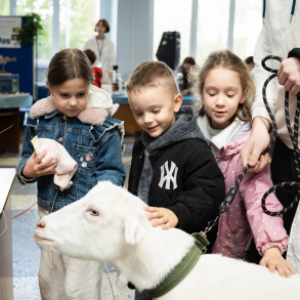
Last Friday, the lobby of Building 22 at Samara University looked anything but a typical academic facility. The air was filled with the scent of aromatic herbs, bacterial colonies under microscopes glowed in bright pink and purple, schoolchildren gently petted a royal python, and a goat posed for photos nearby. Biology Day, a traditional celebration of the Faculty of Biology, featured 15 interactive zones this year.


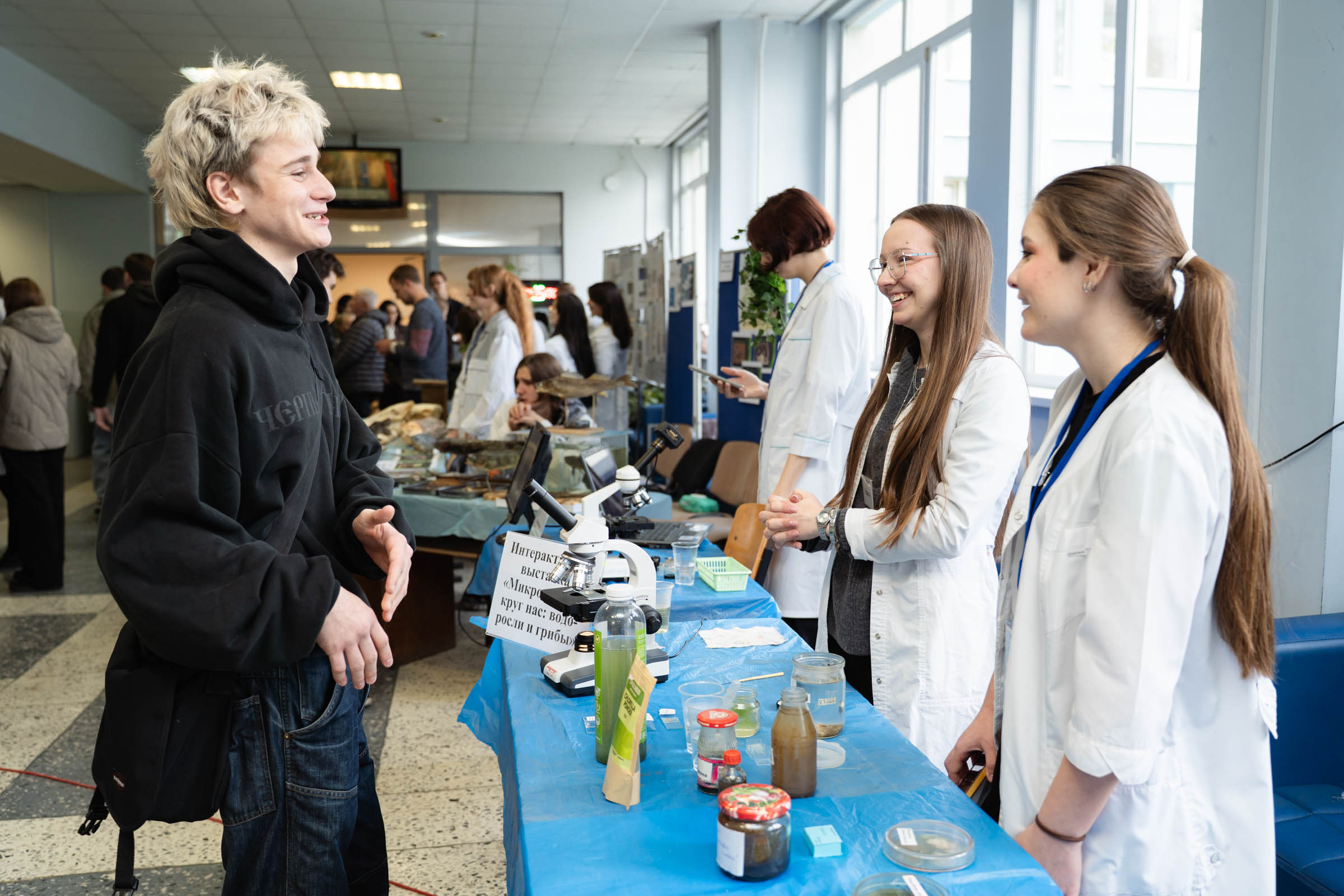

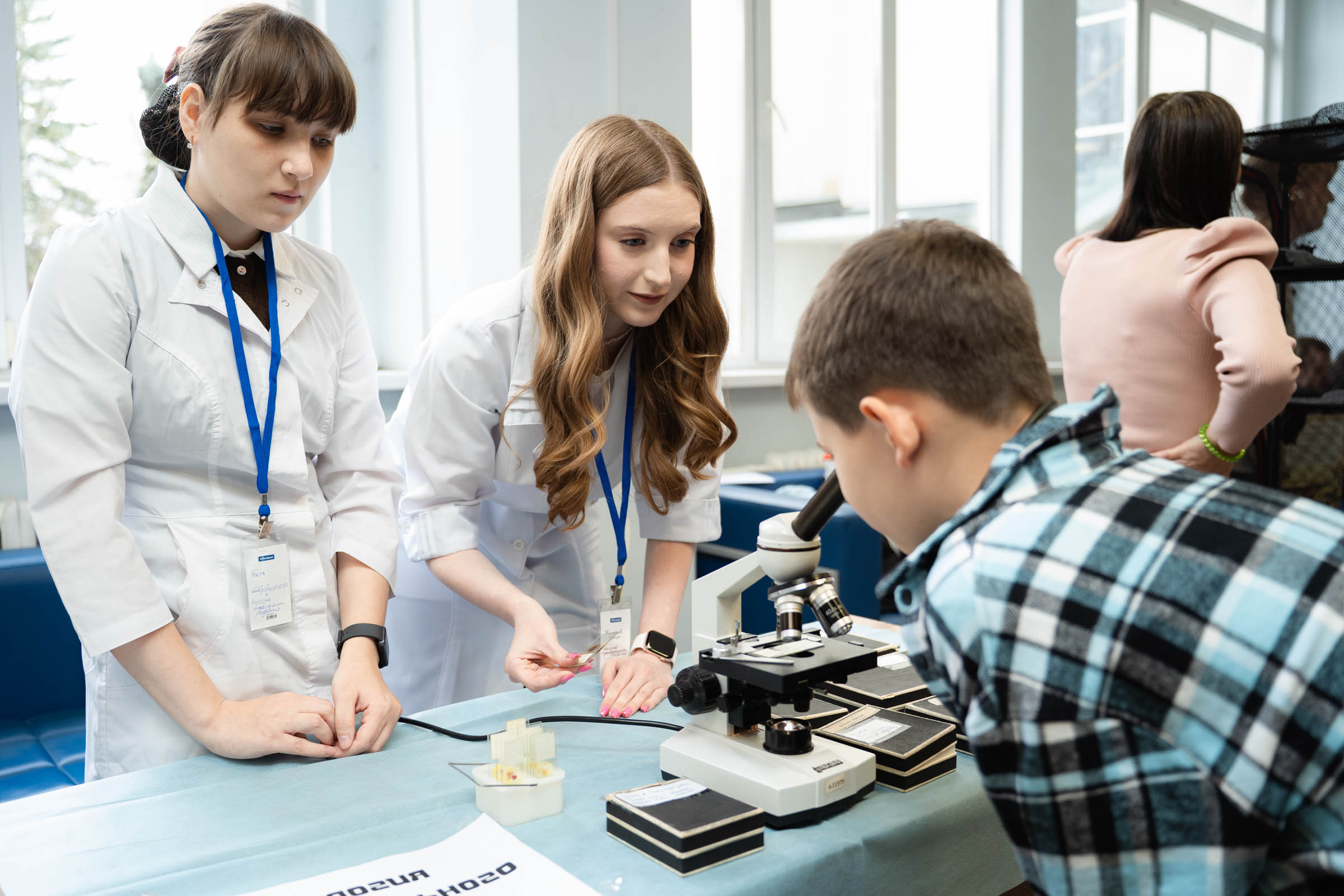
"Biology Day has been held within the walls of Samara University for the sixth year," noted Elena Inyushkina, the organizer of Biology Day and Director of the interactive exhibition space "Smart Butterfly House." "We position it not just as a Faculty of Biology event, but as a celebration of biology as a whole. Our guests included the Zhiguli Nature Reserve, the Samara Zoo, and the Samara Children's Ecological and Biological Center, as well as our partners, such as the 'Mother and Child' clinic and 'Moya Nauka' (My Science)."
The program featured not only exhibitions and workshops but also lectures. Topics included "Orchids of the Samara Region," "An Introduction to the World of Bryophytes (Mosses)," "The Role of a Biologist in a Medical Laboratory," "You Can Never Have Too Much Sleep: All About the Edible Dormouse," "Machine Learning and Artificial Intelligence in the Chemical Design of Biologically Active Compounds," "Prospects for the Development of Assisted Reproductive Technologies: The Use of IVF in Animals," and "The Connection Between Natural Sciences and Machine Learning."
The exhibition was visited by Mark Shleenkov, Acting Minister of Science and Higher Education of the Samara Region; Viktor Soifer, Academician of the Russian Academy of Sciences (RAS) and President of Samara University; and Evgeny Shakhmatov, Academician of the RAS and Scientific Supervisor of Samara University. Accompanied by organizers and faculty, they toured the stations, where they were shown how to identify substances using chemical reactions, how bacteria are stained using the Gram method, and the stages of organism development from a single cell—featuring samples from humans, frogs, chickens, and rats.
The Amazing is Right around Us
The Faculty of Biology was represented by three departments: Ecology, Botany, and Nature Conservation; Human and Animal Physiology; and Biochemistry, Biotechnology, and Bioengineering. Each prepared its own exhibitions and workshops.
"We presented a wide variety of plants, including local flora and species introduced from different regions, as well as tropical and subtropical varieties," said Olga Kalashnikova, Director of the Botanic Garden. "Here, we wanted to show that everything grows from a seed, eventually resulting in immense biodiversity. People are fascinated to learn that the amazing is right here, all around us, and even right under our feet."
Among the scientific projects of the Faculty of Biology, a special place is held by the Digital Herbarium—a virtual copy of the largest plant collection in the Volga-Ural region. The herbarium funds contain over 50,000 sheets, primarily of local flora, as well as samples from other regions of Russia and abroad. Digitization began in 2021, and by mid-2025, approximately 12,000 herbarium specimens had been digitized, with work ongoing.
Each herbarium sheet is scanned in high resolution, so detailed that every hair or fiber on the plant is clearly visible. The scan is supplemented with photographs of the plant in its natural habitat, GPS coordinates of the collection site, and reference information. Geodata linked to each specimen allows for the creation of species distribution maps and the identification of rare and reviving plant species, including those reintroduced thanks to the work of Samara biologists. Thus, a collection that was once accessible only to specialists in storage is now available to scientists and enthusiasts worldwide.
Among the festival guests were representatives of "Wings of the Heavens," a community of people who help birds in distress. Anastasia Lvova brought one of her wards to the celebration: an Eurasian hobby (falcon) named Fikus.
"'Wings of the Heavens' is not an organization or a club," she clarifies. "It is a grassroots community of people who met online and united to help birds. We have no specific center or leader. There are those who know more and understand birds better, and there are those who contribute exactly as much as they can."
Anastasia noted that help is not just about money: "If you have no funds but have a car, you can provide transportation: deliver feed, medicine, or the bird itself. Help can take absolutely any form."
For the first time, festival guests saw live bats. They were presented by Ekaterina Devyatova, a zoologist, veterinarian, specialist in the treatment and rehabilitation of birds and bats, and director of a public organization dedicated to the protection and conservation of bats.
A Rabbit, a Python, a Goat, and More
The Samara Children's Ecological and Biologic Center brought a decorative Lionhead rabbit, a Chinese Silkie chicken, a degu squirrel, and a guinea pig to Biology Day. Representatives of the center explained how these animals are kept and cared for. Nearby, the "Smart Butterfly House" interactive exhibition space was operating, showcasing Professor Sergey Sachkov's unique collection, including regional endemics.
The Samara Zoo's zone was particularly popular. According to Alexander Kuzovenko, Candidate of Biological Sciences and Deputy Director of the Zoo for Development and Scientific-Educational Work, the animal lineup was expanded this time.
"We brought a goat, domestic rabbits, and guinea pigs," Alexander explains. "Among the reptiles were a royal python, a corn snake, two turtles—a European pond turtle and a Central Asian tortoise—a bearded dragon, and Madagascar hissing cockroaches. The European pond turtle is listed in the Red Data Book of the Samara Region. It is very important to show it and talk about it."
He emphasized that contact with animals is a core principle of the zoo: "When you touch an animal, you realize it is a living being. When you look at it through glass, it seems like a picture. We are convinced that this kind of contact can raise a person who is incapable of harming nature."
Answering a question about what he would like to say to students, Alexander Kuzovenko emphasized: "Humans are biosocial beings. We are connected to the environment that has always surrounded us. Knowledge of basic biology (whether an animal is dangerous, whether a plant is poisonous, whether it is safe to eat these mushrooms) is vital for life. We must also know a lot about our own pets."
He added: "If we talk about a child, their world in preschool age consists of a love for animals. Later, we lose it, we forget. I would like this love not to be lost, for this knowledge to be preserved. And the understanding that what is in front of us is not just something beautiful, but something alive—this is the foundation for us to treat our nature with care."
About Blood Donation
The festival also provided information about blood donation. Donated blood is sent to medical institutions in the Samara Region and helps patients in need of transfusions. Samara University has been developing this initiative for many years, with students and staff regularly participating in campaigns to replenish the regional blood bank.
Expanding the Geography
Biology Day is traditionally free and open to everyone: schoolchildren, students, their parents, and city residents interested in learning more about the nature of their native region. The organizers already have plans to expand the geographic reach of participants, inviting organizations not only from Samara and the Samara Region but also from neighboring regions.
Photo: Olesya Orina
