

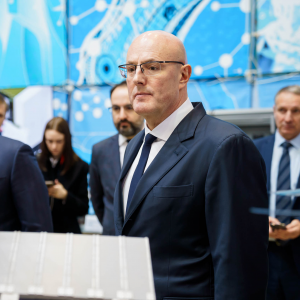
Dmitry Chernyshenko, Deputy Prime Minister of Russia, together with Vyacheslav Fedorishchev, Governor of the Samara Region, appreciated Samara University’s scientific and technical developments.
During his working visit to the Samara Region, the Deputy Prime Minister got acquainted with Samara University’s cyber-physical factory for manufacturing small-sized gas-turbine engines, visiting one of its workshops, the Samara-Technology Centre. Here, digital models and prototypes of small-sized engines – gas-turbine ones, internal combustion ones, liquid rocket ones – are transformed into real “hardware”.


Rector Vladimir Bogatyrev briefly told the Deputy Prime Minister of the Russian Federation about the University’s situation, development and plans, national and federal projects to be participated, in particular, “Priority 2030”, “Advanced Engineering Schools”, “World-Class Research Centres”, “Carbon Landfills” and others.
The young scientists presented Dmitry Chernyshenko their scientific research developments created within the framework of these federal programs. They started with the outcomes of the University’s participation in the project “Advanced Engineering Schools”.
So, Olga Zagorina, a design engineer at the Engineering Centre, presented Dmitry Chernyshenko a robotic intelligent cell developed on the basis of domestic equipment. It is a milling machine equipped with a robotic arm, and is used both for training bachelor’s and master’s degree students, as well as for solving production tasks. The feature of the cell is the option of predictive diagnostics of the technical state of the equipment before introducing it into production.
Evgeny Filinov, scientific director of the Power Plant Youth Laboratory, presented at once several developments to the Deputy Prime Minister. For example, speaking about the prototype of a small-sized gas-turbine engine with a thrust of 20 kgf, intended for unmanned aerial vehicles (UAVs), he emphasized that students of the Youth Design Bureau “DvizhOk” participated in developing the engine design. It is currently at the stage of pre-production, which is being implemented on the basis of 3D Cube LLC, a small innovative enterprise of Samara University.
“We have fully developed the design and technological documentation, conducted preliminary tests of 10 engine samples, and the acceptance tests of 10 more engine prototypes are planned for 2026”, added Evgeny Filinov. “At present, our main task is ensuring its cost to be reduced”.
The scientific director of the youth laboratory also presented a prototype of the basic internal-combustion engine with a capacity of 5 hp. In terms of its technical specifications and dimensions, it corresponds to its foreign equivalent widely used. “The technology has been confirmed in the Laboratory, and last week we tested it in flight conditions”, he added.
Vitaly Smelov, Director of the Institute of Engine and Power Plant Engineering, told the Deputy Prime Minister about metal rubber, a unique material developed at the University, and demonstrated vibration-proof products based on it. “The specificity of the material is that, on the one hand, it is flexible, with the qualities of rubber, on the other hand, it works at temperatures from minus 60 to plus 60 degrees Celsius”, specified Vitaly Smelov. Vibration isolators made of metal rubber are used as supports for the power plants of domestic diesel locomotives manufactured by Sinara-Transport Machines PJSC and Transmashholding CJSC. Currently, the University, together with Sinara-Transport Machines PJSC, is introducing vibration isolators into diesel generator sets of autonomous power plants in the interests of Gazprom.
Besides, the director of the Institute of Engine and Power Plant Engineering told the Deputy Prime Minister about burner devices for the low-emission combustion chamber of the NK36ST power plant. The project is aimed at creating and organizing high-tech production of advanced parts and assemblies of the hot part of industrial gas-turbine engines based on digital twins and technologies of Selective Laser Melting and Laser Direct Deposition. “In this project, additive technologies have made it possible to achieve significant savings in time and production costs: the labor intensity has been reduced by 3.5 times, and the cost of the burners has decreased by 25%. The low-emission combustion chamber provides the engine with the significantly reduced emissions of harmful substances. At present, the small-scale production in the interests of UEC-Kuznetsov PJSC has been deployed”, explained Vitaly Smelov.
The Deputy Prime Minister was also presented the outcomes of participating in the program “Priority 2030” by using specific examples. So, Evgeny Filinov told about the prototype of the small-sized gas-turbine power plant with a capacity of 75 kW. It is designed to generate electrical and thermal energy and can be used in housing and communal services, sports and culture facilities. Advantages of the sample are high resource, low noise and vibration levels, as well as resistance to cold, which is especially important in the Far North. “This is completely our University’s development. The designs and technologies were created by scientists, students and postgraduates. The expected release date of the production model is 2026. The main customer is Gazprom”, said the young scientist.
Commenting on the visit, Anastasia Bondarenko, Deputy Minister of Science and Higher Education of the Russian Federation, noted that at Samara University, all conditions have been created for students to manifest their creative approaches to developing new technologies, “It’s great when a university provides such an opportunity to its students simultaneously with the order from industrial partners. This results, as we can see, in not just abstract developments to emerge, but in something to be in demand, and therefore to be commercialized. And it’s clear that the student teams are working in the competitive environment, striving for improving technology, beating competitors in the price of the products if possible, which means they are doing a very important and necessary thing for developing both the University and our economy”.
Maksim Ivanushkin, Head of the cyber-physical factory of small-sized spacecrafts (SSS), presented the space development to the Deputy Prime Minister. It is about the small-sized radar spacecraft “AIST-ST”. “AIST-ST” is expected to be launch into orbit from the Vostochny cosmodrome in the near future. Students and young scientists of the University participated in the work on the device.
“AIST-ST” is the first Russian 16-unit satellite in the cubesat format, equipped with radar survey equipment that allows for all-weather monitoring of the Earth’s surface, to be required for monitoring the Arctic and the Northern Sea Route”, said Maksim Ivanushkin. The data sent from the device will be received by the ground-based small-sized spacecraft control system deployed on the University’s territory, and the results of the development will be used when working with teams of schoolchildren within the framework of the program “Planet Duty Officer” of the Innovation Promotion Foundation. The industrial partner of the project is the Special Technology Centre from St. Petersburg, which develops the main payload.
“Are you working on reducing the SSS weight?” asked the Deputy Prime Minister. “Yes, we are”, replied the young scientist. “But there are limitations related to radar equipment”.
By the way, Dmitry Chernyshenko was given a model of this small-sized spacecraft as a souvenir.
David Ovakimyan, Director of the University’s Centre for Unmanned Systems, presented Dmitry Chernyshenko a vertical takeoff unmanned aircraft of high-duration flight, with the hybrid propulsion system and a universal UAV with advanced autonomy “Unidrone”.
Developments in the field of artificial intelligence were presented to Dmitry Chernyshenko by Artem Nikonorov, Director of the University’s Institute of Artificial Intelligence. The University’s Centre for Intelligent Mobility of Multifunctional Unmanned Aircraft Systems, AI created at the Institute, won the federal competition of the centres in the field of artificial intelligence. The program developed by the Centre is aimed at conducting research in the field of artificial intelligence, as well as creating applied solutions for developing the domestic unmanned aviation industry.
Speaking about them, Yulia Vybornova, Deputy Director of the Centre for Artificial Intelligence, mentioned key frameworks. So, using the framework “Navigator”, you can create solutions for controlling an unmanned aerial vehicle. The C-80 UAS model, or agrodrone, was presented at the stand. Its route planning software was developed, given flight zones. There are also the software for planning the simultaneous processing of agricultural fields by several agrodrones. Another framework is called “Monitor” and is designed for the remote monitoring of objects from the UAS using various cameras: visible range, infrared range, hyperspectral cameras. The third framework “Tekhekspluatatiya” is used for creating software tools for ensuring the safety of production and operational processes.
The Centre’s specialists have created the video monitoring system for pre-flight training of the UAS operator. The system allows monitoring in real time the operator’s performance of all necessary manipulations before launching the drone and, in case of anomalies, transmitting the launch-lock signal to the drone’s remote control and the flight control centre.
At the end of the inspection of the exhibition of scientific developments, the Deputy Prime Minister was presented the analogue photonic computing system. Currently, under the scientific program of the National Centre for Physics and Mathematics (NCFM), with the support of the Rosatom State Corporation, the University’s scientists has created a demonstration sample of a high-performance photonic processor. The device operates on a new, photonic component base, in which information is transmitted by light particles, and not by electrons, as in conventional computers. The analogue photonic computing system has already made it possible to analyze and recognize objects hundreds of times faster than modern digital neural networks based on conventional semiconductor computers. This is especially important for the operational analysis of hyperspectral data, which initially represent significant arrays of information. The photonic processor is configured to work with another development by the University, a hyperspectrometer, which allows scientists to create a three-dimensional array of image data simultaneously in two bands.
During the visit, the Governor of the Samara Region also drew Dmitry Chernyshenko’s attention to the fact that Samara University is a key beneficiary of the interuniversity campus project. “We are ready to invest significant financial resources in creating the new environment for transforming the universities into third-generation universities – innovative and technological ones. The unique advantage of the Samara campus will be indoor and outdoor testing grounds for technologies and developments in real conditions”, emphasized Vyacheslav Fedorishchev.
“The Samara Region actively uses government support measures in the field of education and science. Samara University is a striking example of how participating organizations in these large-scale programs help develop the region’s human and technological potential and thereby contribute to achieving the goals set by the President of the Russian Federation”, said the Deputy Prime Minister at the end of the visit.
